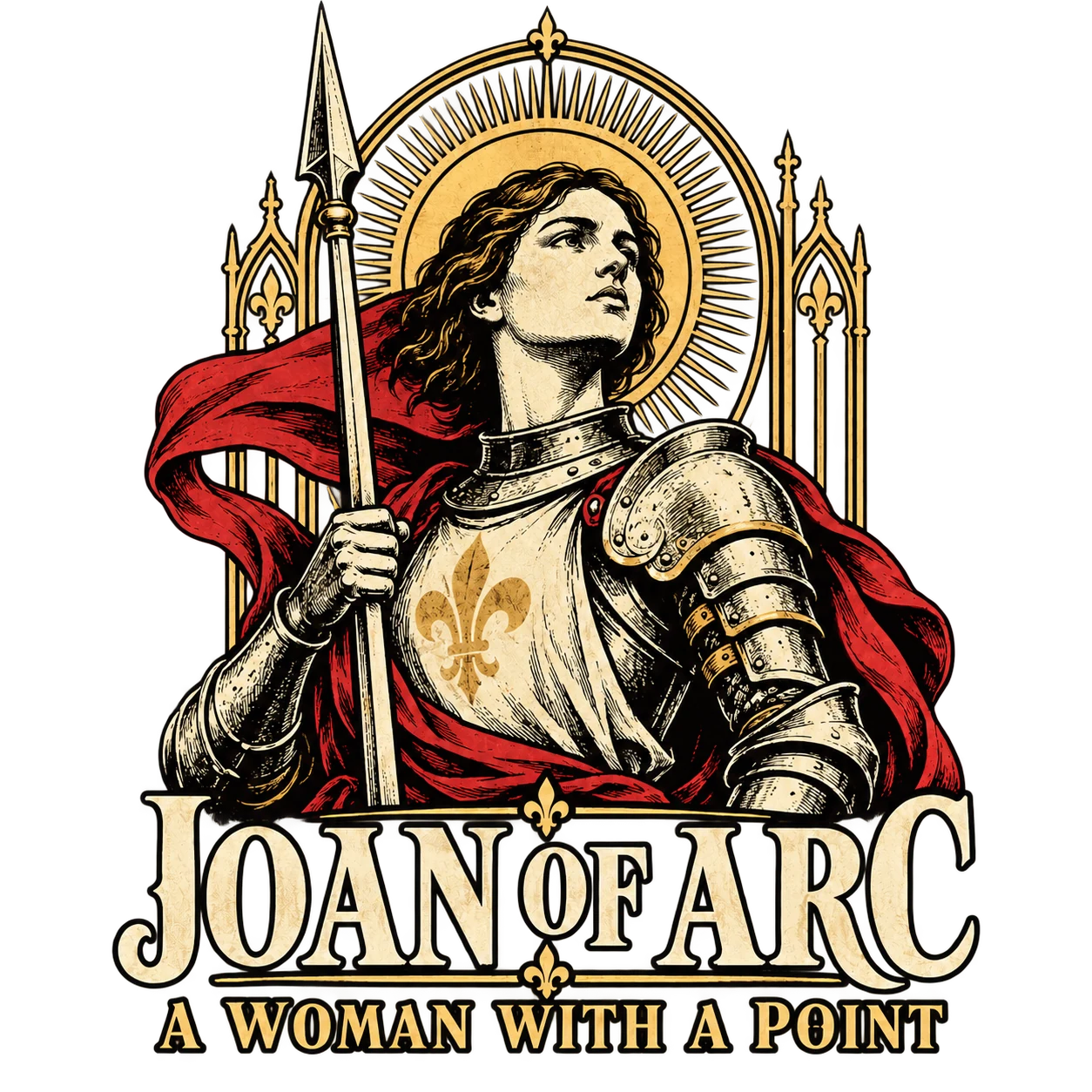
Portrait made with AI image tools from our own research and art direction. No portrait of her from life survives; this one is an interpretation.
In the portrait: The fleur-de-lis on her surcoat and in the arches is the lily of the French crown, the cause she rode for. The gothic arches recall Reims, where she stood beside Charles VII at his crowning in 1429. The halo is the one the Church gave her in 1920, nearly five centuries after a church court sent her to the fire.
№ 001 · c. 1412–1431
Saint Joan of Arc
Also known as Jeanne d’Arc; Jehanne; the Maid of Orléans
In the Archive · Shirt coming soon
Joan of Arc was a peasant teenager who helped turn a war around, stood beside a king at his coronation, then faced a court of men so boldly that her trial record still sounds dangerous today.
Remember her for this
In November 1429 Joan sent the town of Riom a letter asking for gunpowder and military equipment for a siege. A clerk wrote it out; Joan signed it. It is the earliest of her signatures known to survive, and it is just her first name: “Jehanne”.
Her story
At about seventeen, Joan of Arc decided that the adults in charge of her country were doing it wrong, and crossed a war zone to tell them. That part of her story can get lost beneath six centuries of armour, halos, statues and sainthood.
Before she became an icon, she was a teenage girl from Domrémy, a village on the unstable eastern edge of a France fractured by the Hundred Years’ War. She had no title, no army, no political office and no obvious route into the rooms where decisions were made. What she had was certainty.
Joan said that she heard heavenly voices telling her that she must help Charles, the French dauphin, and aid the struggle against English power in France. Plenty of people in medieval Europe had religious visions. Joan’s gift was for turning conviction into action, and she kept going until somebody listened.
She persuaded local supporters to help her reach Charles’s court. Clerics examined her. She faced suspicion and questioning, and the plain absurdity of her position as a village teenager telling princes and commanders that she knew what needed to happen next. Somehow, she got through.
In 1429 Joan was allowed to accompany the French campaign to Orléans, then under English siege. Experienced commanders, soldiers and political forces all shaped what followed, but Joan mattered. She pushed for action and became a visible source of courage and momentum. Soldiers and supporters could look at her and believe that defeat was not inevitable. The siege was lifted.
Joan wanted more. Charles had not yet been crowned at Reims, the traditional coronation city of French kings, and getting him there meant travelling through contested territory, but Joan pressed the case. In July 1429 Charles was crowned Charles VII, and Joan stood nearby with her banner.
A few months earlier she had been a village teenager with no recognised authority. Now she was standing inside one of Europe’s great political rituals, having helped drive events towards it. She had no conventional power, so she learned to make influence out of belief, persistence, symbolism and a sheer refusal to go away.
None of this got easier once people knew her name. In May 1430 she was captured by Burgundian forces and eventually transferred to English custody. At Rouen she was put on trial before a church court, which examined everything that made her troublesome: her claimed voices, her independence, her clothing, her refusal to submit neatly to the authorities questioning her.
The trial record is one of the reasons Joan still feels startlingly close. Alongside the legend of a brave girl, we have pages of a young woman being questioned by powerful, educated men who already understood the danger she represented, and answering them with nerve and intelligence, refusing to be manoeuvred into the responses they wanted.
She was about nineteen when she was burned at Rouen on 30 May 1431. In 1456 a new church inquiry annulled the earlier verdict. In the centuries since, she has been made into every imaginable symbol: saint, patriot, warrior, victim, heretic, feminist icon. None of them captures her completely.
Underneath them all is a young person with almost none of the kinds of power her society recognised. History is full of people told, explicitly or otherwise, that important things were somebody else’s business. Joan looked at a crisis far larger than herself and refused to accept that this made her irrelevant. She kept knocking on doors until one opened, then stepped through it and acted as though she belonged in the room.
The trouble with Joan of Arc
Joan behaved as if conviction could be a source of authority even when birth, wealth, gender and office said otherwise. That set her against several systems at once: class hierarchy, gender expectations, clerical authority and the political order created by English and Burgundian control. What made her dangerous was less the fighting than her claim to an authority no institution had granted her. She arrived, insisted on being heard, and changed what happened next.
What the usual story gets wrong
-
“Joan of Arc led France’s armies single-handed.”
Verdict: Oversimplified
Popular retellings often turn Joan into either a lone battlefield general or a passive mystical mascot. She was neither. She never commanded France’s armies single-handed, but she took part in campaigns, pressed strategic objectives, inspired troops and political supporters, and insisted on a route to Reims that mattered enormously to Charles VII’s legitimacy.
-
“She was a shepherd girl.”
Verdict: Oversimplified
The court asked her. Joan said that at home she did the ordinary household work and did not go out to the fields with the sheep. Once she was older, she helped drive the animals to the meadows, or to a castle for safety from soldiers, but did not usually look after them; she could not remember whether she had as a small child. The craft she claimed was sewing and spinning, at which she “feared no woman in Rouen”.
-
“She was burned for wearing trousers.”
Verdict: Oversimplified
The trial’s interest in her men’s clothing was real, and it mattered at the end: after her recantation, the judges questioned her on why she had resumed men’s dress, and it became part of the case for relapse. But it was one strand of a broader heresy case, tangled up with her claimed revelations and questions of obedience.
-
“She was burned as a witch.”
Verdict: Oversimplified
The prosecutor asked for her to be declared a witch, an enchantress and a caller-up of evil spirits, and her final sentence still lists “invocation of demons” among her crimes. But what sent her to the stake was relapse. Days after signing a recantation, she told her judges her voices came from God and that she had recanted “only for fear of the fire”. On 30 May 1431 they declared her a relapsed heretic.
-
“We know what Joan of Arc looked like.”
Verdict: Little evidence
No authenticated likeness survives. The only picture made in her lifetime is a clerk’s imagining, and every modern face is an interpretation.
Sources & rabbit holes
The trial record preserves an unusually long run of Joan’s answers in her own reported words, and the rehabilitation inquiries of the 1450s took sworn evidence from her neighbours, her comrades and men who had sat through her trial. Neither is neutral: the first court was run by judges aligned with the English, the second was pursued under the king she had helped to crown, and its witnesses were remembering events a quarter of a century old. Her own hand survives only in a few signatures.
Primary sources
-
Lettre de Jeanne d’Arc aux Riomois (opens in a new tab)
A photograph of the letter itself: a clerk’s request for gunpowder and military equipment, with her signature at the foot.
-
The Trial of Jeanne d’Arc (opens in a new tab)
The whole condemnation trial in English, session by session, from her first argument over the oath to the sentence of 30 May 1431.
-
Jeanne d’Arc, Maid of Orleans, Deliverer of France (opens in a new tab)
Prints the rehabilitation depositions of 1455–56, where neighbours from Domrémy, her comrade Dunois and witnesses at Rouen describe the Joan they knew.
Museums & archives
-
1429 – Jeanne d’Arc, le premier portrait (opens in a new tab)
In French: the only picture of Joan made in her lifetime, a sketch six centimetres high in the margin of a Paris court register, drawn by a clerk who was imagining her.
Academic papers
-
Charisma and Routine: Shaping the Memory of Brother Richard and Joan of Arc (opens in a new tab)
Open access. Uses Max Weber’s idea of charisma, authority that comes from the person rather than the office, to ask how her contemporaries handled Joan and the apocalyptic preacher Brother Richard.
Books
-
Joan of Arc: A History (opens in a new tab)
Starts at Agincourt, fourteen years before Joan appears, so that she arrives in the middle of a civil war rather than a legend; built closely on both trial records.
Watch
-
Eleanor Janega Answers Joan Of Arc Google Questions (opens in a new tab)
Twenty minutes, free: a medieval historian takes the questions people actually search for, from what she looked like to whether she led the army.
Listen
-
In Our Time: The Siege of Orléans (opens in a new tab)
Three historians of the Hundred Years’ War on whether Joan really rescued Orléans, and how much the siege changed the war.
-
You’re Dead to Me: Joan of Arc (opens in a new tab)
The comedy history podcast, with Helen Castor as the historian: her sewing, her soldiering, and why sainthood took so long.