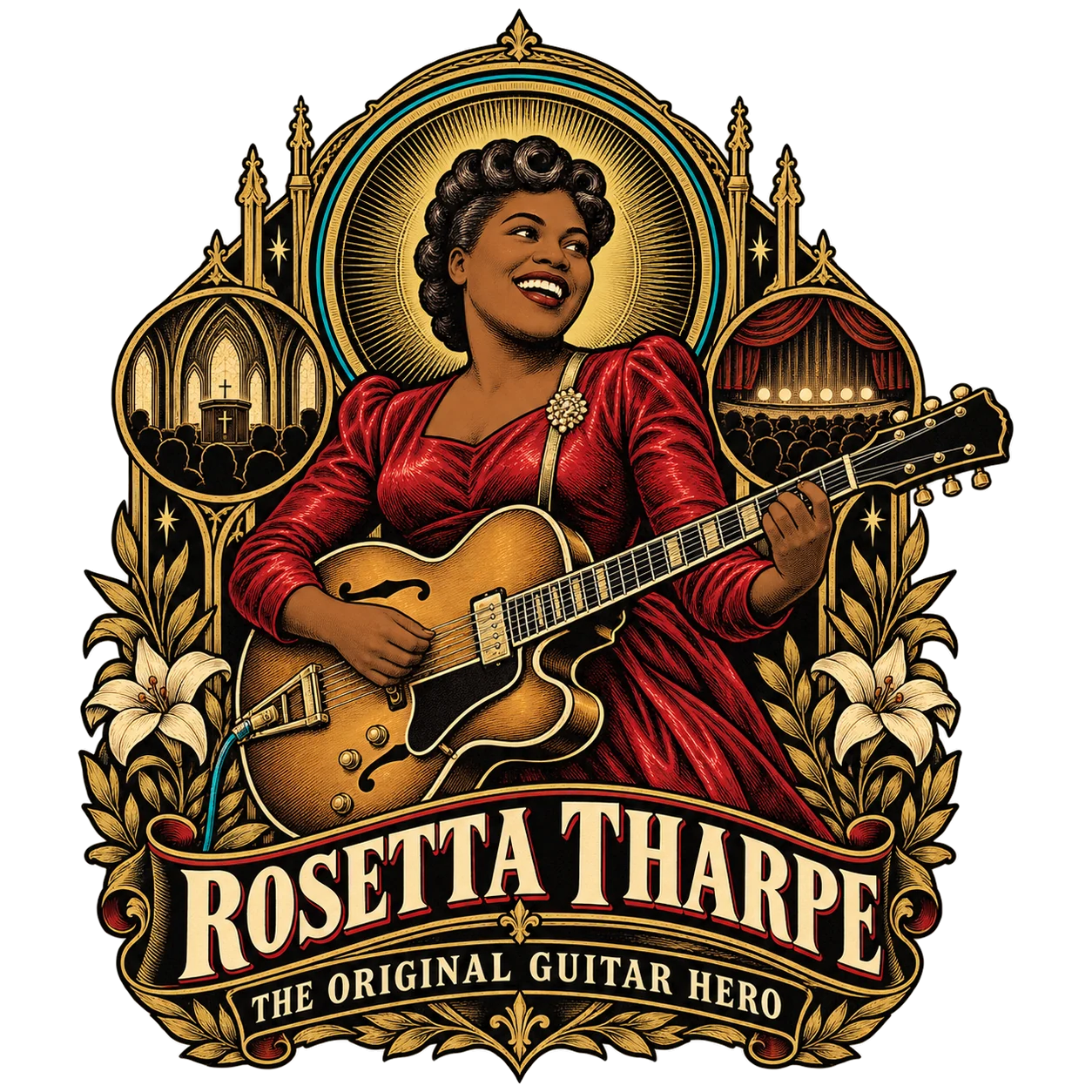
Portrait made with AI image tools from our own research and art direction.
In the portrait: The roundels are the two rooms she sang in, church and nightclub, and many church listeners thought sacred songs had no business in the second. She plays an electric archtop guitar, the instrument she put at the front of the band before rock and roll had a name.
№ 019 · 1915–1973
Sister Rosetta Tharpe
Also known as Rosetta Nubin; Rosetta Atkins
In the Archive · Shirt coming soon
Sister Rosetta Tharpe took gospel and her guitar from church to the Cotton Club and Carnegie Hall, then plugged in, playing what later performers would call rock before it had a name.
Remember her for this
In 1964 Granada Television staged a gospel and blues show at a disused railway station in south Manchester. Sister Rosetta Tharpe arrived by horse-drawn carriage, strapped on a white electric guitar and played “Didn’t It Rain” to an audience across the tracks. The whole scene was staged. The rain was real.
Her story
Before rock and roll had settled on a name, Sister Rosetta Tharpe was standing in evening clothes with an electric guitar, singing church music loudly enough to unsettle both church and nightclub.
She was born in Cotton Plant, Arkansas, in 1915. No birth certificate was issued, and she used two surnames, her father’s and her mother’s; her biographer, Gayle Wald, gives her name as Rosie Etta Atkins. Her mother, Katie Bell Nubin, was a musician and evangelist in the Church of God in Christ, a Black Pentecostal denomination that welcomed instruments and gave women work as evangelists and missionaries, though it would not ordain them. By six Rosetta was billed as a singing and guitar-playing miracle, travelling with her mother through churches and revival meetings.
They moved to Chicago, where gospel music was becoming a modern urban business. Rosetta learned from storefront churches, blues players, jazz bands and the theatre of worship. In 1938, aged twenty-three, she signed with Decca and recorded “Rock Me”, “That’s All”, “My Man and I” and “The Lonesome Road”. The records sold. She played the Cotton Club, and appeared at John Hammond’s From Spirituals to Swing concert at Carnegie Hall.
To many church listeners, sacred songs in nightclubs were a betrayal. To nightclub audiences, a Black woman playing guitar at the centre of a swing band was not the act they expected. Tharpe declined both objections by becoming a star.
Her guitar did more than accompany her voice. She played rhythmic chords, stinging single-note runs and distorted attacks that later performers would call rock. Recorded in 1944 with the pianist Sammy Price, “Strange Things Happening Every Day” reached No. 2 on Billboard’s race-records chart in 1945. It is often called the first gospel record to cross into rhythm and blues.
Rock and roll grew out of Black gospel, blues, rhythm and blues, country and boogie-woogie, and from many musicians moving ideas between them. Tharpe was one of the people already playing it, before anyone wrote its history: a gospel musician, a woman and a guitarist at the front of the band. Chuck Berry, Little Richard and Johnny Cash heard what she was doing. So did the guitar stars who came after them.
From 1946 she toured and recorded with the gospel singer Marie Knight, and their close musical partnership produced some of Tharpe’s finest work. Wald describes them as romantic partners too. Knight, interviewed many times for the biography, denied it.
On 3 July 1951 she married Russell Morrison, who became her manager, before thousands of paying spectators at Griffith Stadium in Washington, then played a gospel concert in her wedding dress. It was promotion, performance and an actual wedding, and it was recorded and released.
Her American popularity declined as the younger rock stars she had influenced filled the charts. Europe listened differently. In 1964 the Granada television programme Blues and Gospel Train staged performers at a disused railway station in south Manchester. Tharpe arrived by horse-drawn carriage, strapped on a white electric guitar and played “Didn’t It Rain” across the tracks. The rain, at least, was genuine.
She had a stroke in 1970, and later lost a leg to diabetes. She went on performing, and died in Philadelphia in 1973. Her grave was unmarked for years. In 2018 the Rock & Roll Hall of Fame inducted her as an Early Influence. By then several generations of guitar heroes had spent sixty years playing variations on what she had already taken to church.
The trouble with Sister Rosetta Tharpe
Sister Rosetta Tharpe would not keep church music in church, or herself at the back of the band. She took gospel into nightclubs and an electric guitar into gospel before the histories of rock went looking for their first guitar hero. To many church listeners it was a betrayal. Nightclub audiences had not expected a Black woman with a guitar at the front of the band. She became a star.
What the usual story gets wrong
-
“Sister Rosetta Tharpe invented rock and roll.”
Verdict: Oversimplified
No one person invented it. Rock and roll grew from Black gospel, blues, rhythm and blues, country and boogie-woogie, and from many performers moving ideas between them. Tharpe was a crucial architect and influence, and in 2018 the Rock & Roll Hall of Fame inducted her as an Early Influence.
-
““Strange Things Happening Every Day” was the first rock and roll record.”
Verdict: Disputed
Recorded in 1944, it reached No. 2 on Billboard’s race-records chart in 1945, and it is often called the first gospel record to cross into rhythm and blues. Whether it was the first rock and roll record depends on where rock and roll is said to begin. Record-company publicity and later rock histories have both liked a single point of invention.
-
“She was the first electric guitarist.”
Verdict: False
Electric guitar experiments and recordings came before her. What set her apart was the commanding, rhythmically aggressive way she played the instrument, and how many people heard her play it.
-
“The 1964 railway performance was an accidental concert caught on film.”
Verdict: False
It was staged for Granada Television’s Blues and Gospel Train. The disused station, the horse-drawn carriage, the audience platform and the train imagery were all production. The performance was live, and the rain was real.
-
“Her church rejected her, and she left gospel for rock.”
Verdict: Oversimplified
Some church listeners objected to nightclubs and secular sounds, but Tharpe went on singing gospel throughout her career. She never made a clean conversion from one genre to another. The categories moved around her.
Sources & rabbit holes
The core evidence is her own: the records, from the 1938 Decca sessions on, and the filmed performances, among them Granada’s Blues and Gospel Train. The Smithsonian’s Ralph Rinzler Folklife Archives holds a copy of Decca’s 1951 LP of her stadium wedding and concert, and the Rock & Roll Hall of Fame’s library and archives hold her artist files and photographs. Claims about who invented rock and roll, or made its first record, are arguments rather than measurements. Gayle Wald’s 2007 biography, Shout, Sister, Shout!, is the standard account of her life, including her private life, her musical networks and how audiences heard her.
Primary sources
-
Wedding ceremony of Sister Rosetta Tharpe and Russell Morrison (opens in a new tab)
The archive record for the LP of her wedding and the gospel concert that followed, recorded at Griffith Stadium in Washington on 3 July 1951, with the track list.
Museums & archives
-
Sister Rosetta Tharpe (opens in a new tab)
Her induction page from 2018, which calls her “the first guitar heroine of rock & roll”, with an essay on her career and the musicians she shaped.
-
Sister Rosetta Tharpe (opens in a new tab)
The museum library’s guide to her recordings, films, photographs and influences, and to the Rock Hall archive collections that include her.
-
Sister Rosetta Tharpe: The Godmother of Rock and Roll (opens in a new tab)
Objects from across the Smithsonian’s collections, from photographs and record sleeves to her 1998 stamp, with a short account of the gospel star and her Gibson SG.
-
Sister Rosetta Tharpe (opens in a new tab)
From the museum’s Women on Stamps exhibition: her 1998 stamp, her strict church upbringing, and how she brought the sounds of jazz and swing into gospel.
-
Down by the Riverside (opens in a new tab)
Her 1944 recording, added to the National Recording Registry in 2004, with an essay by her biographer Gayle Wald and a link to listen.
Books
-
Shout, Sister, Shout! The Untold Story of Rock-and-Roll Trailblazer Sister Rosetta Tharpe (opens in a new tab)
The standard biography, built from the memories of more than 150 people who knew her. When it first appeared, she still lay in an unmarked grave.
-
The Gospel Sound: Good News and Bad Times (opens in a new tab)
The classic history of the gospel world she came from, its singers and its networks. Free to borrow online with an Internet Archive account.
Further reading
-
Sister Rosetta Tharpe, From Gospel to Electric Guitar-Driven Rock ’n’ Roll (opens in a new tab)
A short piece on her first recording session, on 31 October 1938 at the age of twenty-three, and the stars she inspired, from Chuck Berry to Little Richard.