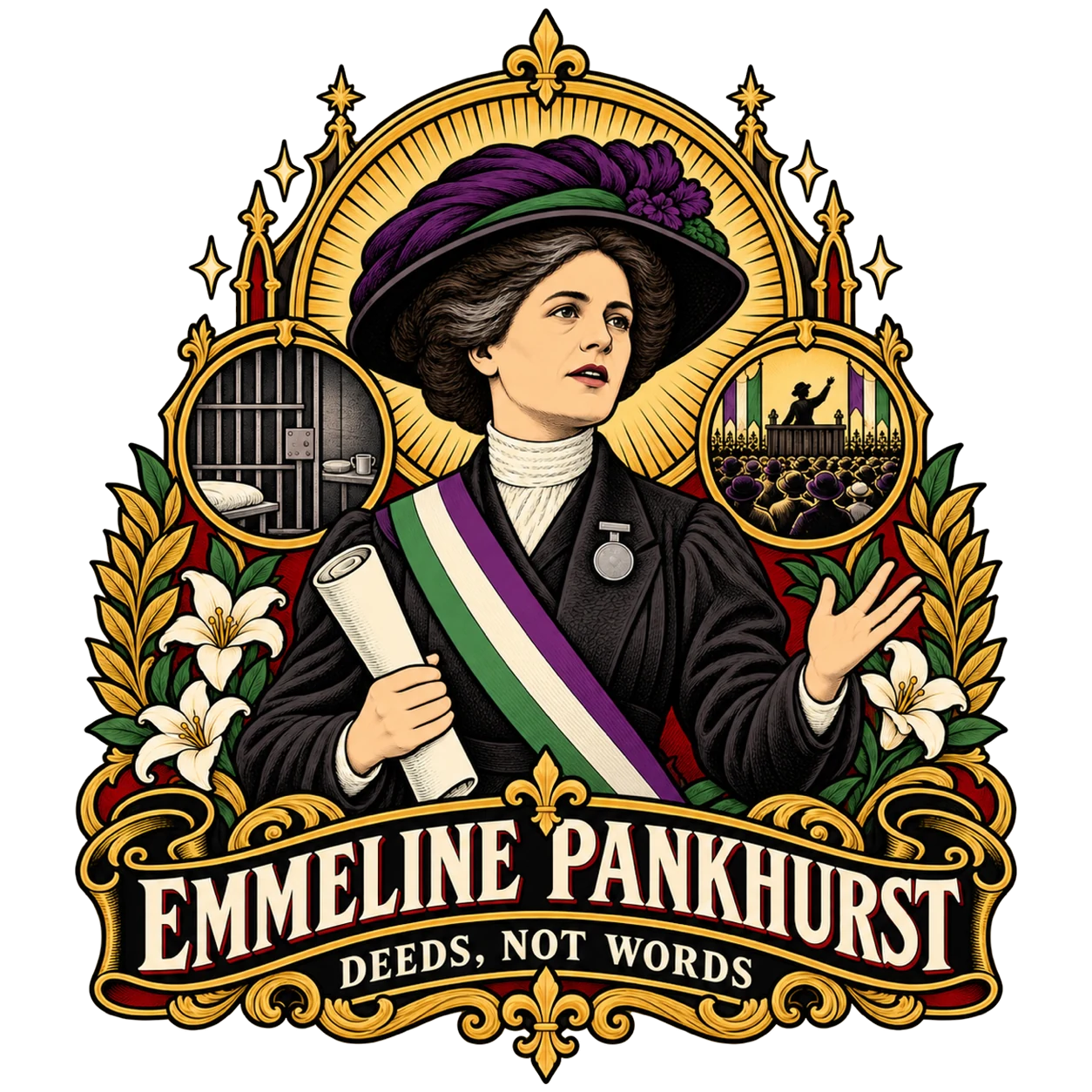
Portrait made with AI image tools from our own research and art direction.
In the portrait: She is drawn mid-speech, as she spent the campaign: addressing the meetings the WSPU held, and interrupting the ones it was kept out of. The left roundel is a prison cell, for the hunger strikes after which the state released her when she was dangerously ill and rearrested her once she recovered.
№ 016 · 1858–1928
Emmeline Pankhurst
Also known as Emmeline Goulden Pankhurst
In the Archive · Shirt coming soon
Emmeline Pankhurst helped found the Women’s Social and Political Union at her Manchester home, went to prison and on hunger strike for votes for women, and made them a question Parliament could no longer put off.
Remember her for this
In 1910 and again in 1912 Stanley Baldwin, then an MP, voted against a women’s suffrage bill. Emmeline Pankhurst went to prison and on hunger strike. By 1928 Baldwin was Prime Minister, and his government gave women the vote on the same terms as men, eighteen days after she died. In 1930 he unveiled her statue.
Her story
In October 1903 a small meeting at Emmeline Pankhurst’s home in Manchester formed the Women’s Social and Political Union. Its demand was votes for women, and its motto was “Deeds, not words”. Parliament had already had plenty of words.
She had been born Emmeline Goulden in Manchester in 1858, into a politically active family. She married Richard Pankhurst, a barrister who drafted laws improving married women’s property rights and supported women’s suffrage, and they had five children. When he died in 1898 she was left with grief, debts and years of organising behind her.
Women and men had been campaigning for the vote by constitutional means for decades. The WSPU brought central discipline, theatrical confrontation and a willingness to make normal politics impossible while women were shut out of it.
In October 1905 her eldest daughter, Christabel, and Annie Kenney, an Oldham mill worker, interrupted a Liberal meeting at the Free Trade Hall in Manchester and were arrested. From there the campaign escalated: demonstrations, attempts to enter Parliament, window-breaking, attacks on post boxes, arson and damage to property. Pankhurst defended militancy as a planned answer to political refusal. She was arrested repeatedly, once for incitement after the WSPU called a “rush” on Parliament in 1908.
Prison became another battleground. Suffragettes demanded to be treated as political prisoners, and hunger strikes were met with brutal force-feeding. Under the Prisoners (Temporary Discharge for Ill Health) Act of 1913, nicknamed the Cat and Mouse Act, prisoners weakened by hunger strike could be released and then rearrested once they recovered. Pankhurst went on hunger strike herself, and was released and taken back again and again.
The tactics split the suffrage movement. Millicent Fawcett’s much larger National Union of Women’s Suffrage Societies (NUWSS) kept to constitutional work. Inside the WSPU, Emmeline and Christabel ran an increasingly authoritarian organisation. They expelled critics. In 1912 that meant their own treasurer, Emmeline Pethick-Lawrence, and her husband, Frederick, who together edited the WSPU’s newspaper, Votes for Women. Their quarrels with her other daughters, Sylvia and Adela, broke the family apart. Sylvia was expelled from the WSPU in January 1914. That year Pankhurst gave Adela £20 and a letter of introduction, and advised her to emigrate to Australia. They never spoke again.
Beyond the WSPU, constitutional suffragists, working-class organisers and thousands of local campaigners pursued the vote by their own methods, sometimes in furious disagreement with Pankhurst and with one another.
When war began in 1914, Pankhurst called off militancy and backed the British war effort. She and Christabel campaigned for military recruitment and for women’s work in industry, while Sylvia opposed the war and organised relief in the East End. In November 1917, with a franchise bill still before Parliament, Emmeline and Christabel turned the WSPU into the Women’s Party. Pankhurst’s politics turned nationalist and anti-Bolshevik, and later Conservative.
The Representation of the People Act 1918 gave the vote to some women over thirty who met property conditions. It also enfranchised millions of men who had not had the vote before. Women under thirty, many of them war workers, were still shut out. In 1927 the Conservatives adopted Pankhurst as their prospective candidate for Whitechapel and St George’s, in the East End.
She died on 14 June 1928, before she could face the electorate. Eighteen days later, on 2 July, the Equal Franchise Act became law, giving women the vote on the same terms as men, at twenty-one. Millicent Fawcett was there to see it.
The trouble with Emmeline Pankhurst
Emmeline Pankhurst would not accept that asking politely was the same as being heard. She organised women to interrupt meetings, march on Parliament, break windows and fill the prisons, and turned their exclusion from politics into a public-order problem. She made refusal costly, and forced a government that preferred to discuss women indefinitely to deal with women acting.
What the usual story gets wrong
-
“Emmeline Pankhurst won votes for women.”
Verdict: False
She led one important organisation in a campaign built by generations of suffragists and suffragettes. Millicent Fawcett’s NUWSS was much larger than the WSPU, and local organisers, constitutional campaigners, working-class groups and the political changes of wartime all played their part.
-
“British women got the vote in 1918.”
Verdict: Oversimplified
Only some of them did. The 1918 Act enfranchised women over thirty who met property conditions; women under thirty, many of them war workers, were still shut out. Equal voting terms with men came in 1928.
-
“Suffragettes and suffragists were the same.”
Verdict: False
“Suffragette” became the name for militant campaigners, the WSPU’s above all. “Suffragist” usually describes the wider constitutional movement, particularly the NUWSS.
-
“The suffragettes’ militancy set the cause back.”
Verdict: Disputed
Historians still argue about its effect. Militancy forced attention and built urgency; it also alienated supporters and gave opponents material.
Sources & rabbit holes
Pankhurst made her own case in My Own Story (1914), a political argument for her strategy as much as a memoir. Government and police files are rich, because the state watched the WSPU closely, but they show it through its watchers’ eyes. In December 1916 she wrote to David Lloyd George, who had just become Prime Minister, asking to see him before his new cabinet was settled and promising “wholehearted support” to win the war. The letter is now in the Parliamentary Archives. June Purvis’s 2002 biography is the major modern life, and Diane Atkinson’s Rise Up, Women! (2018) keeps her in the company of the wider movement.
Primary sources
-
Suffragettes on file, 1840–1912 (opens in a new tab)
Original documents with transcripts, from a Chartist poster to a 1912 letter to “Mrs Pankhurst” and an issue of The Suffragette, on the movement’s tactics, its prisoners, the WSPU and the government’s response.
-
Letter from Emmeline Pankhurst to Lloyd George (opens in a new tab)
Written in December 1916 to the new Prime Minister, with a transcript, from the years when she suspended militancy and recruited women into war work.
-
My Own Story (opens in a new tab)
Free to read. Her account of the militant campaign, in her own voice, published in 1914.
Museums & archives
-
Emmeline Pankhurst (opens in a new tab)
Her campaign through the government’s own files: prison petitions in her words, papers seized from WSPU headquarters, and the close watch the state kept on her.
-
Women’s suffrage campaigners: Emmeline Pankhurst (opens in a new tab)
A chalk portrait of her from about 1908 in the Parliamentary Art Collection, with a short account of her militancy, her hunger strikes and her support for the war effort.
Books
-
Emmeline Pankhurst: A Biography (opens in a new tab)
The major modern biography, by a leading historian of the suffrage movement.
-
Rise Up, Women! The Remarkable Lives of the Suffragettes (opens in a new tab)
A broad history of the movement told through the lives of the women in it, which keeps Pankhurst in the company she led.
Further reading
-
The vote for some (opens in a new tab)
What the 1918 Act actually gave: the vote to nearly all men over 21, but to women only at 30 and with a property qualification, and the ten more years it took to win equal terms.
-
90th anniversary of the Equal Franchise Act 1928 (opens in a new tab)
A short briefing on the 1928 Act that gave women the vote on the same terms as men, adding about five million women to the register.