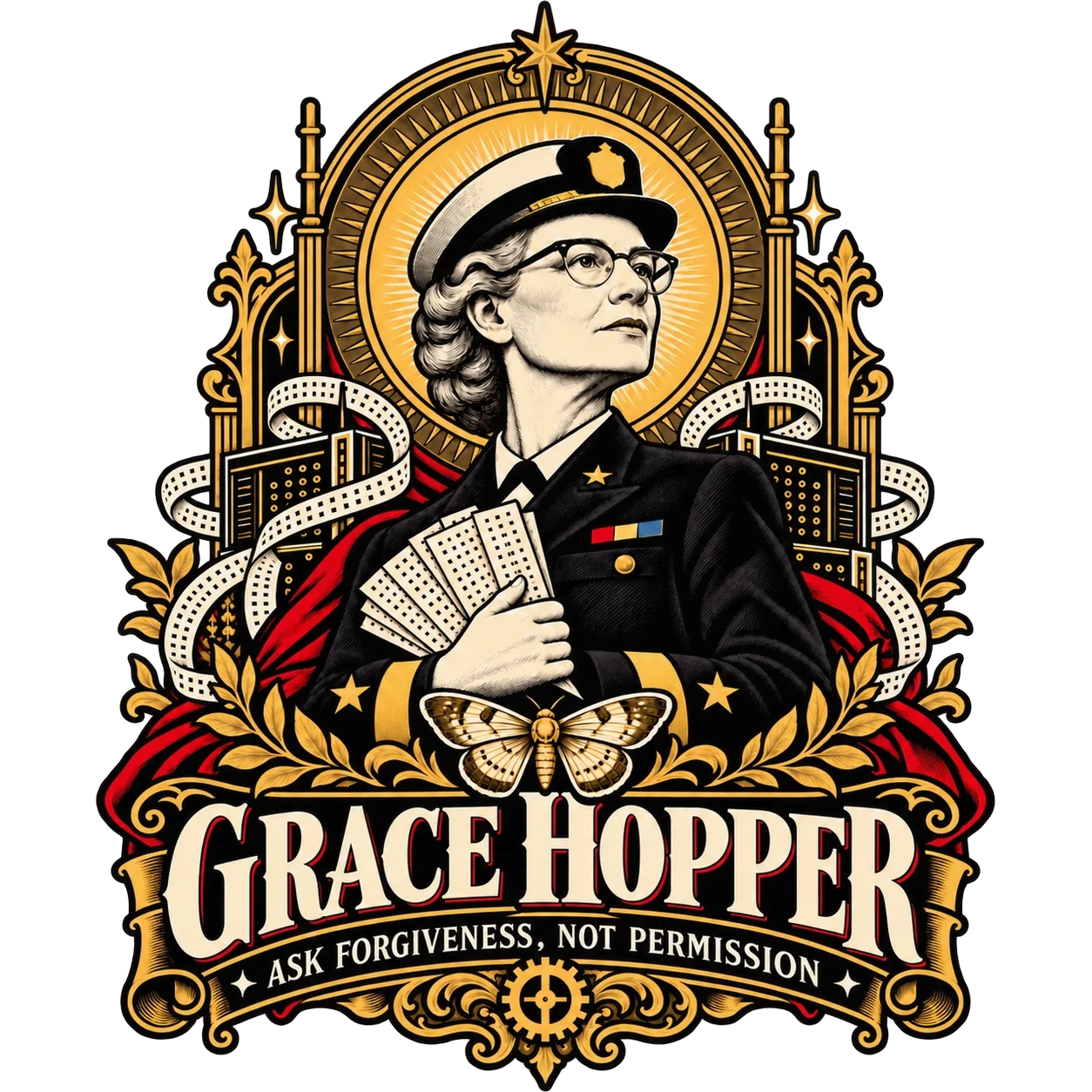
Portrait made with AI image tools from our own research and art direction.
In the portrait: The punched paper tape and the cabinets behind her are the Harvard Mark I, the first computer she programmed. The moth is the one her team taped into the Mark II’s logbook in 1947. The punched cards in her hand stand for the programs that followed, many written in the English-like languages she championed.
№ 005 · 1906–1992
Rear Admiral Grace Hopper
Also known as Grace Brewster Murray Hopper; Grace Murray Hopper; Amazing Grace
In the Archive · Shirt coming soon
Grace Hopper spent decades making it easier for people to tell computers what to do, and would not let her age, cautious institutions or ‘we’ve always done it this way’ get in the way.
Remember her for this
At the end of 1966 the Navy retired Grace Hopper for being too old. She called it the saddest day of her life. Seven months later the Pentagon phoned and asked her back. She stayed nineteen years, and when she finally left in 1986, aged seventy-nine, she was the oldest serving commissioned officer in the U.S. Navy.
Her story
Grace Hopper’s favourite enemy was inertia. The sentence “we’ve always done it this way” bothered her so much that she spent decades warning people about it, which makes sense once you look at her career. She entered computing when almost everything about the field was still being invented. There was no sacred tradition to protect yet, just problems, machines and whatever worked.
Born in New York in 1906, Hopper studied mathematics and physics and earned a PhD in mathematics from Yale in 1934. During the Second World War she joined the U.S. Naval Reserve and was assigned to Howard Aiken’s computing project at Harvard, where she met the Mark I.
The Mark I was enormous, electromechanical and nothing like the computers we now take for granted. Programming early machines demanded intimate knowledge of how they operated, and the human had to learn to think in ways the machine could understand.
Hopper asked a wonderfully irritating question about that arrangement. Why should every programmer spend their energy translating human intentions into the most awkward language possible, when the computer could be made to do more of that work?
Today the answer feels obvious, because layers of software stand between most programmers and the electronics underneath. In Hopper’s era it was not obvious at all.
She worked on early compiler systems, programs designed to translate higher-level instructions into machine operations. Later she developed FLOW-MATIC, which used English-like statements for business data processing. FLOW-MATIC became one of the important influences on COBOL, the committee-developed language that went on to run enormous parts of government and business computing.
She was one of the people who kept pushing computing towards humans, and that takes imagination, because specialists can become very attached to difficulty. If you have spent years learning a complicated system, making it easier for the next person can look like lowering the standard. To Hopper a computer was a tool, and making the tool more usable meant more people could solve more problems.
Her teaching had the same instinct. She was famous for making abstract ideas tangible. To explain a nanosecond, she handed people lengths of wire representing roughly how far light travels in that time. She wanted people to understand what was happening rather than simply be impressed by it.
Hopper’s military career kept running into institutional rules about age and service. She retired, returned, was recalled again and eventually rose to rear admiral. When she finally retired in 1986, aged seventy-nine, she was the oldest commissioned officer then serving on active duty in the U.S. Navy.
Her most famous line is “It’s easier to ask forgiveness than it is to get permission.” Our shirt shortens it to ASK FORGIVENESS, NOT PERMISSION, the version people immediately recognise.
It is easy to turn that into a motivational slogan about doing whatever you like, but Hopper’s own work was about making systems function. The trouble with asking permission too often is that established systems naturally favour the way things already are. Every gatekeeper has learned the old process, every form assumes the old answer, and every improvement arrives looking inconvenient. Sometimes progress needs somebody willing to build the better thing first, and Hopper did that repeatedly.
She helped make programming more accessible, challenged the idea that obscurity proved sophistication, outlasted attempts to put her career neatly to bed, and taught generations of people to question assumptions that had quietly hardened into rules.
The trouble with Grace Hopper
Grace Hopper looked at systems everyone had learned to tolerate and asked whether they could simply be better. Her recurring enemy was institutional inertia. Of machines, bureaucracies and professional habits alike, she wanted to know who had decided they had to stay this way. She challenged the assumption that programmers should adapt themselves to machines, when languages could be designed to make machines adapt to people, and she kept returning to service after being told she was too old.
What the usual story gets wrong
-
“Grace Hopper invented the word ‘bug’ when a moth got into a computer.”
Verdict: False
Grace Hopper did not invent the words ‘bug’ or ‘debugging’. Engineers had used ‘bug’ for faults since the nineteenth century. The Mark II team really did find a moth in a relay and tape it into the logbook as the ‘first actual case of bug being found’; Hopper was part of the team and later helped popularise the story.
-
“Grace Hopper invented COBOL.”
Verdict: Oversimplified
COBOL was designed by a committee. Hopper was a major advocate for machine-independent, English-like languages, her FLOW-MATIC influenced COBOL, and she was part of the wider effort that made it possible.
-
“Grace Hopper wrote the first compiler.”
Verdict: Oversimplified
Yale and the Computer History Museum both call her 1952 A-0 system the first compiler. The IEEE’s 2024 milestone citation describes it more narrowly, as having “functioned as a linker/loader”. Whether it was the first compiler depends on how strictly the word is defined.
-
“Hopper said ‘Ask forgiveness, not permission’.”
Verdict: Oversimplified
The line ‘Ask forgiveness, not permission’ is a tightened version of a quip strongly associated with Hopper; the Naval History and Heritage Command quotes her as saying, ‘It’s easier to ask forgiveness than it is to get permission.’
-
“She was the first woman to earn a PhD in mathematics at Yale.”
Verdict: False
Yale had been awarding mathematics doctorates to women since 1895; Asher Auel’s 2019 study of her Yale records counts her among the first dozen. Her thesis was in pure algebra, supervised by Øystein Ore, rather than the ‘mathematical physics’ that many accounts still give her.
Sources & rabbit holes
The core evidence is her official Navy biography, the Mark II logbook page, and her own lectures and interviews, including a long 1980 oral history now held by the Computer History Museum. Her retellings are lively but not always exact. For her mathematics, the best guide is Asher Auel’s 2019 study of her Yale records.
Primary sources
-
New Types of Irreducibility Criteria (opens in a new tab)
Her doctoral thesis in pure algebra, supervised by Øystein Ore, with the diagrams she drew by hand. It was never published in full; in 1934 it appeared only as a one-paragraph abstract.
-
Oral History of Captain Grace Hopper (opens in a new tab)
A long interview recorded while she was back on active duty. On why she wanted programs written in English: “I knew darn well most people didn’t like symbols.”
Museums & archives
-
The First “Computer Bug” (opens in a new tab)
The Navy’s photograph of the Mark II logbook page for 9 September 1947, with the moth taped beside the entry. Its caption says this introduced the term ‘debugging’. The Smithsonian, which now holds the logbook, says more carefully that the team helped popularise it.
-
Hopper, Grace Murray (opens in a new tab)
Her official Navy biography from 1981, written while she was still serving: postings, promotions and awards, year by year. The online transcription has a few typos in its dates.
Academic papers
-
The Mathematics of Grace Murray Hopper (opens in a new tab)
Free to read. Works from her Yale transcript and thesis to show what she actually studied, and corrects errors that most biographies repeat.
Books
-
Grace Hopper and the Invention of the Information Age (opens in a new tab)
A history of her work from 1945 to 1960, written against the simplified version of her life that the press told in her later years.
Watch
-
Capt. Grace Hopper on Future Possibilities: Data, Hardware, Software, and People (Part One, 1982) (opens in a new tab)
Her 1982 lecture to NSA staff, recovered from old videotape with the National Archives’ help and released in 2024; Part Two is on the same channel. She tells the moth story herself, and dates it two years early.
Further reading
-
Code, Commission, and Character: The Unstoppable Career of Rear Adm. Grace Hopper (opens in a new tab)
The Navy’s own account of the 1967 phone call that brought her back from retirement, and of the forgiveness-and-permission line the shirt is built on. Celebratory rather than exact: it dates her commission a year early.
-
Milestones: A-0 Compiler and Initial Development of Automatic Programming, 1951–1952 (opens in a new tab)
The IEEE milestone plaque at the University of Pennsylvania, dedicated in 2024. The plaque’s citation is reliable; the background text beneath it contains errors.