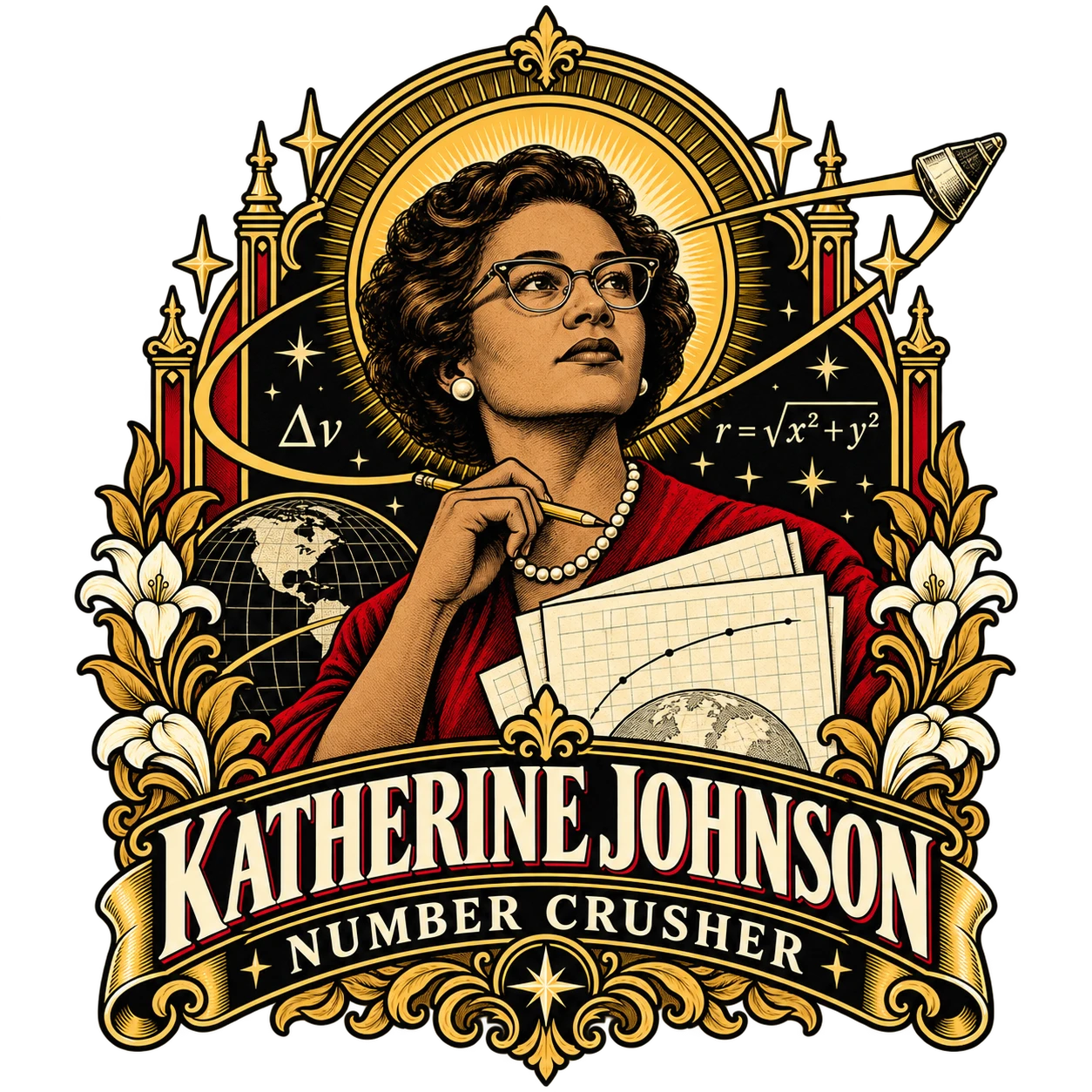
Portrait made with AI image tools from our own research and art direction.
In the portrait: The capsule riding the orbit is a Mercury spacecraft, like the one that carried John Glenn around the Earth in 1962 after she had checked its numbers. Δv is the change of speed a spacecraft needs to alter its path; r = √(x² + y²) gives its distance from the centre of the Earth. The pencil and graph paper are how she did it.
№ 007 · 1918–2020
Katherine Johnson
Also known as Katherine Goble Johnson; Katherine Coleman Goble Johnson
In the Archive · Shirt coming soon
Katherine Johnson’s maths for America’s first crewed spaceflights was so reliable that John Glenn wanted her to check the new computer’s numbers before he flew.
Remember her for this
In 1960, Katherine Johnson and engineer Ted Skopinski published the maths for sending an orbiting spacecraft over a chosen point on Earth, the point where its journey home would begin. No woman in her division had ever been credited as an author of a research report. On the cover of this one, after his name, it says “and Katherine G. Johnson.”
Her story
Imagine preparing to sit on top of a rocket, knowing that whether you come home depends on mathematics. Now imagine looking at the new computer’s answer and telling the engineers to get the girl to check it. That is the story NASA tells about John Glenn’s 1962 orbital mission. The girl was Katherine Johnson, and she was trusted with the numbers that human lives depended on.
Johnson was born in White Sulphur Springs, West Virginia, in 1918, and her ability with mathematics was obvious from early on. Local schooling for Black children stopped before the level she needed, so her family moved to let the children carry on their education. Katherine raced through school and entered college at fifteen.
At West Virginia State College her professors recognised a mind that wanted to know why the numbers behaved the way they did. That curiosity eventually brought her to the National Advisory Committee for Aeronautics (NACA) in 1953.
The institution she joined was segregated. Groups of women performed the mountains of calculation that aeronautical research required. They were called “computers”, because computing was the job, and Black women were assigned to the segregated West Area Computing unit.
The system could easily have kept Katherine there. Instead her ability in analytic geometry and trajectory calculation moved her into flight-research teams. She asked questions, went to meetings and worked with engineers on problems that grew more urgent as the United States moved from aircraft research into the space race.
When NACA became NASA in 1958, the new agency needed to know exactly where a human being would go once it had thrown one into space. Katherine knew how to calculate it, and in 1961 she worked on trajectories for Alan Shepard’s Freedom 7 mission, the first American human spaceflight.
The year before, she and engineer Ted Skopinski had published a report on bringing an orbiting spacecraft over a chosen point on Earth. For years women had done indispensable technical work while the credit went elsewhere. This time her name was on the cover.
Then electronic computers arrived, faster than teams of people working through calculations by hand but new enough that trust still had to be earned. John Glenn was preparing to become the first American to orbit Earth. The machines produced his flight calculations, and Glenn wanted Katherine Johnson to verify them.
“If she says they’re good,” Johnson later remembered him saying, “then I’m ready to go.”
A Black woman born in segregated West Virginia had become the person an astronaut wanted between himself and the unknown. She checked the numbers, and Glenn orbited Earth successfully.
It is tempting to turn the story into Katherine-versus-the-computer, the brilliant human beating the machine, but Johnson had no quarrel with the machines. She helped build the mathematical understanding that made them useful, and once electronic computing arrived, her expertise became the standard the new tools were tested against.
Her work continued into the Apollo era, including calculations connected with lunar missions, and later into Space Shuttle and Earth-resources programmes. She retired from NASA in 1986 after more than three decades.
For much of that time, people outside NASA had little idea who she was. That changed dramatically when the story of Black women mathematicians at NASA entered mainstream culture, though her importance had been there in the work all along.
She changed the system by becoming so good at what it needed that it had to move around her. She asked to attend the meeting, learned the problem better than anyone expected, insisted that her contribution carry her name, and went back to the page until the trajectory closed and the spacecraft had a way home.
The trouble with Katherine Johnson
Katherine Johnson worked inside institutions that were structured by racial segregation and gender hierarchy and built to underestimate Black women, while doing mathematics they increasingly could not function without. She asked to be in the room, did the work, put her name on the report and made the numbers undeniable.
What the usual story gets wrong
-
“Hidden Figures shows it as it happened.”
Verdict: False
The film Hidden Figures brought Johnson and other Black women mathematicians at NASA to a huge audience, but it is a dramatisation that compresses and invents events, including the launch-pad scene below.
-
“Katherine Johnson put America in space.”
Verdict: Oversimplified
NASA missions were giant collaborative projects, and no lone mathematician ‘put America in space’. Johnson’s part was trajectory analysis, orbital calculations and research authorship, and the trust others placed in her work.
-
“The John Glenn story was invented for the film.”
Verdict: False
NASA itself records Johnson’s recollection that John Glenn asked engineers to ‘get the girl’ to verify the electronic computer’s results before his orbital flight.
-
“She checked Glenn’s numbers while he waited on the launch pad.”
Verdict: False
That scene is the film’s invention. Johnson worked at Langley in Virginia; Mission Control was in Florida, not at Langley as the film has it, and the check took her at least a day and a half, not the seconds it takes on screen. Exactly when Glenn asked is not documented. Johnson remembered it as “weeks before” the flight.
-
“She was a ‘human computer’ in a calculating pool.”
Verdict: Oversimplified
The historical term ‘computer’ could refer to a person performing calculations, but Johnson’s later work was much broader than simply being a ‘human computer’ in a pool.
Sources & rabbit holes
The core evidence is NASA’s own: her 1960 report with Ted Skopinski, the later reports she wrote or co-wrote, and NASA’s biographies, which draw on her interviews with Margot Lee Shetterly. Glenn’s request for her rests on Johnson’s own recollection, told decades later, though the check itself made her known in the African American press after the flight. Since 2016 the film Hidden Figures has shaped how her story is told.
Primary sources
-
Determination of Azimuth Angle at Burnout for Placing a Satellite Over a Selected Earth Position (opens in a new tab)
The 1960 report itself, scanned in full in NASA’s technical reports archive, with both names on the title page.
-
What Matters; Katherine Johnson: NASA Pioneer and “Computer” (opens in a new tab)
A television interview in which she tells the Glenn story and how she got into the engineers’ briefings by asking whether there was a law against it; the archive’s transcript, which it has not checked for accuracy, is on the page, though the video may only play in the United States.
Museums & archives
-
Katherine Johnson Biography (opens in a new tab)
The author of Hidden Figures writing for NASA: the clearest short account of her career, from West Virginia to the Medal of Freedom.
-
Katherine G. Johnson (opens in a new tab)
NASA’s profile, which credits the Glenn story to Johnson’s own recollection and records that she asked to join editorial meetings no woman had attended before.
-
Katherine Johnson, Hidden Figures, and John Glenn’s Flight (opens in a new tab)
A Smithsonian space-history curator sets the film’s version of Glenn’s flight against the record.
Books
-
Hidden Figures: The Untold Story of the African American Women Who Helped Win the Space Race (opens in a new tab)
The history the film was based on, built from interviews with Johnson and her colleagues and from Langley’s records.
Watch
-
Best of the National Book Festival: Margot Lee Shetterly, 2017 (opens in a new tab)
Shetterly in conversation at the 2017 National Book Festival, free to watch, with audience questions from 27 minutes in.
Listen
-
Last Word: Katherine Johnson, Nexhmije Hoxha, Sir Michael Berridge, Diana Serra Cary (Baby Peggy) (opens in a new tab)
Radio 4’s obituary programme, broadcast less than two weeks after her death, with archive of Johnson in her own words; hers is one of four lives in the episode.
Further reading
-
When the Computer Wore a Skirt: Langley’s Computers, 1935–1970 (opens in a new tab)
How Langley’s computing pools worked, including the segregated West Computers where she started.
-
‘Hidden Figures’: When did John Glenn ask for ‘the girl’ to check the numbers? (opens in a new tab)
Why nobody can say exactly when Glenn asked for her, including Shetterly on her search through the Mercury records.