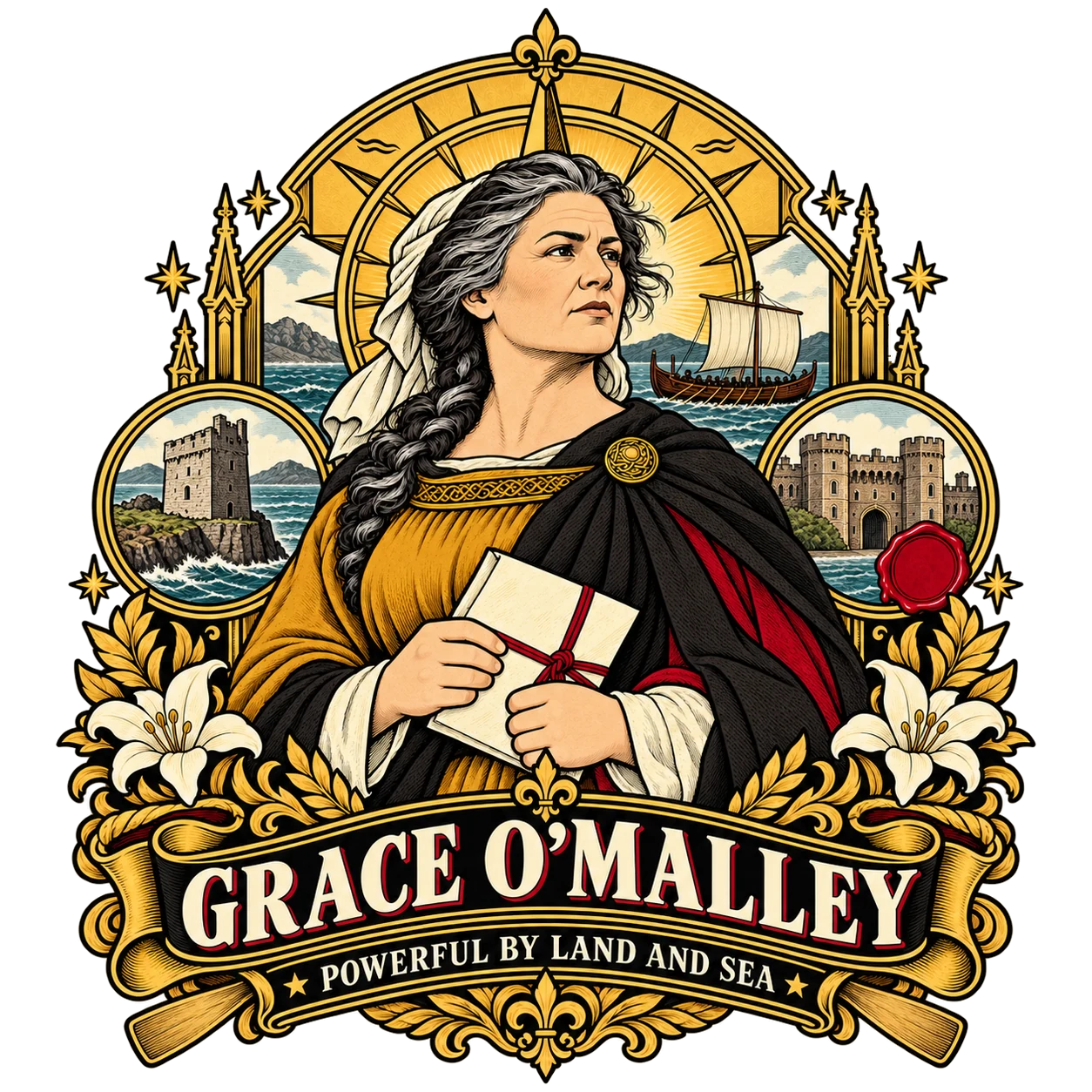
Portrait made with AI image tools from our own research and art direction. No portrait of her from life survives; this one is an interpretation.
In the portrait: The galley behind her stands for her family’s power at sea: they traded, fished, fought and charged ships for using their waters, and the tower house in the left roundel for their land. The petition, the castle gate and the wax seal are her case to Elizabeth I, which she put in person at Windsor in 1593 and won.
№ 017 · c. 1530–c. 1603
Grace O’Malley
Also known as Gráinne O’Malley; Gráinne Ní Mháille; Gráinne Mhaol; Granuaile
In the Archive · Shirt coming soon
Grace O’Malley commanded galleys, collected sea tolls and fought English governors, then sailed to England in her sixties to put her case to Elizabeth I face to face.
Remember her for this
In 1576 Grace O’Malley offered the English lord deputy, Sir Henry Sidney, three galleys and two hundred fighting men. Recalling it in 1583, he called her “a most famous feminine sea captain”. In 1593, in her sixties, she was at Windsor, putting her case to his queen in person.
Her story
In July 1593 Grace O’Malley answered eighteen questions from Elizabeth I’s chief minister, Lord Burghley, about her parents, marriages, sons, lands, widow’s rights and how she had lived since her last husband died. Her answers were the paperwork for a meeting between two women who both expected to govern.
O’Malley was born around 1530 into the Uí Mháille, a Gaelic maritime dynasty on the west coast of Ireland. In Irish she is Gráinne Ní Mháille, or Granuaile. The family’s power came from cattle and land, and also from galleys, fishing, trade and the right to charge vessels for using their waters. For the O’Malleys the Atlantic was a road, a border and a source of income.
She married Dónal an Chogaidh O’Flaherty and had three children. After his death she stayed active among the O’Flaherty kin and their ships. Her second marriage, to Richard an Iarainn Burke, linked two powerful families. Later tradition has her marrying him for one year under Gaelic law, then dismissing him by shouting from a castle that he was no longer required.
English officials noticed her because she had ships, armed followers and no habit of behaving like a governor’s dependant. In 1576, at Galway, she offered the English lord deputy, Sir Henry Sidney, her service with three galleys and two hundred fighting men. Looking back on it in 1583, Sidney called her “a most famous feminine sea captain”. In other English papers she was a nurse to rebellions, a receiver of Scots mercenaries and a spoiler of islands. She was a regional lord, in a sea economy where toll, trade, raid and protection changed names according to who wrote the report.
In 1584 Connacht got a new English governor, Sir Richard Bingham, and he set about breaking the networks that sustained her family. In 1586, during the Burke rising, his brother, Captain John Bingham, arrested her and tied her with a rope. She faced the threat of hanging, and was released only when a hostage was given for her. That year Bingham’s soldiers also killed her son Owen. In 1593 Bingham imprisoned her son Theobald, accused of treason over a letter to the rebel Brian Óg O’Rourke, and her brother, accused of being among men who had killed some soldiers.
So, in her sixties, O’Malley sailed to England. In a petition to the queen she said that disorder in Connacht had forced her to take up arms and maintain herself and her people by sea and land for forty years. She asked for a living from her late husbands’ lands, and for licence to “invade with sword and fire” all the queen’s enemies. Before Elizabeth would receive her, Burghley sent her the eighteen questions. In her answers, which survive in the state papers, she said she had given up that trade and now lived a poor farmer’s life. She asked for her son and brother to be freed.
The two women met at Windsor Castle in September 1593. Elizabeth ordered inquiries, and told Bingham to release the prisoners and to allow O’Malley a livelihood. O’Malley had taken her quarrel with the governor over his head, to the queen in person, and she had done it through the English government’s own paperwork: petitions, interrogatories and orders. Bingham dragged his feet. When she threatened to go back to the queen, he gave way: by 24 November 1593 he had freed her son and her brother.
She was still alive in 1601, when an English naval captain reported chasing one of her galleys onto the rocks off Donegal: thirty oars, a hundred musketeers, and a son of hers in command. She probably died around 1603. The English papers that had called her a nurse to rebellions were still reporting her galleys.
The trouble with Grace O’Malley
Grace O’Malley would negotiate, raid, submit or rebel, whichever kept her family and its galleys in business. English governors wanted a local widow’s obedience. They got a sea captain with three galleys and two hundred fighting men, who took her quarrel with the governor of Connacht over his head to the queen, and came away with orders in her favour.
What the usual story gets wrong
-
“Grace O’Malley was a pirate queen.”
Verdict: Oversimplified
English officials called her acts piracy when they challenged English authority. She led a Gaelic maritime lordship, whose galleys traded, collected tolls, fought, raided and offered protection along the coast, and her own political world did not sort those things into the English categories. “Pirate queen” is the modern headline.
-
“She shaved her head so her father would let her go to sea.”
Verdict: Little evidence
The story explains her later name, Gráinne Mhaol, “bald Gráinne”, but no contemporary source records it. Where the nickname came from is uncertain.
-
“At Greenwich she refused to bow, and she and Elizabeth spoke Latin.”
Verdict: Little evidence
None of it is in the contemporary record of the audience. The refusal to bow, because she did not recognise Elizabeth as queen of Ireland, comes from later stories, and so do the Latin, the concealed dagger, and the sneeze, the handkerchief and its disposal in a fireplace. Even the setting is legend: in September 1593 the queen was at Windsor Castle, away from plague in London, not at Greenwich. The two women may have had interpreters or shared some language. Her written petitions were prepared in English.
-
“She married Richard Burke for one year, then dismissed him by shouting from a castle.”
Verdict: Little evidence
It is an excellent story, and later tradition tells it: a one-year marriage under Gaelic law, ended from a castle with the news that he was no longer required. The surviving record does not prove it. What it does show is that the marriage linked two powerful families.
-
“She gave birth to a son on a ship, then fought pirates the next day.”
Verdict: Little evidence
The story comes from tradition, and the English state papers do not record it. Her biographer Anne Chambers says she found a Latin document confirming the incident, but she has not identified it, so it cannot yet be checked.
Sources & rabbit holes
Most of what was written about her in her lifetime was written by the expanding English state: her petitions, the eighteen interrogatories and her answers, official correspondence and accusations, now among the State Papers for Ireland at The National Archives. They show how much she mattered at sea and in politics, but they describe her in the terms of the officials she was fighting. No portrait of her from life survives. The first full biography was not written until the twentieth century, and folklore filled the gaps, so her dates, the stories of her childhood, the conversation with the queen and her appearance all remain uncertain. Anne Chambers’s biography is the standard modern life, though some of its scenes are reconstructions.
Primary sources
-
A Chorographical Description of West or H-Iar Connaught (opens in a new tab)
Free to read. A description of west Connacht written in 1684, published with James Hardiman’s notes, which record local traditions such as a castle on Inishbofin said to have been built by “the celebrated heroine Grana Weale”. The traditions were written down long after her lifetime.
-
Calendar of the State Papers relating to Ireland, 1592–1596 (opens in a new tab)
Free to read. English summaries of the government’s Irish papers for these years, including the eighteen questions put to her in July 1593, her answers and her petitions. The summaries are in the editor’s words; the originals are at The National Archives.
Museums & archives
-
State Papers Ireland, Elizabeth I to George III (SP 63) (opens in a new tab)
The catalogue entry for the English government’s Irish papers, where her petitions, her answers to the eighteen questions put to her in 1593 and officials’ letters about her survive.
-
The Elizabethan Court Day by Day: 1593 (opens in a new tab)
Free to read. A day-by-day record of Elizabeth I’s court; the 1593 volume gathers the letters and petitions around her visit, and notes that all that is certainly known of the meeting comes from the queen’s letter of 6 September and a later petition.
Academic papers
-
O’Malley, Gráinne (Grace) (opens in a new tab)
Free to read. The most reliable short life, built on the state papers: her marriages, her feud with Sir Richard Bingham, her 1593 journey to the queen and her last years.
Books
-
Grace O’Malley: The Biography of Ireland’s Pirate Queen 1530–1603 (opens in a new tab)
The biography that restored her to Irish history when it first appeared in 1979; this edition adds transcripts of sixteenth- and seventeenth-century manuscripts. Some scenes are reconstructed, so read them as the author’s interpretation.
-
A New History of Ireland, Volume III: Early Modern Ireland 1534–1691 (opens in a new tab)
The standard collaborative history of the period, for the wider political and social world of the Ireland she lived in. Subscription access online.
Further reading
-
Gráinne Mhaol, pirate queen of Connacht: behind the legend (opens in a new tab)
A short, clear look at what the records say about her and how the legend grew, from the politics of Gaelic Connacht to the last report of her galley at sea in 1601.