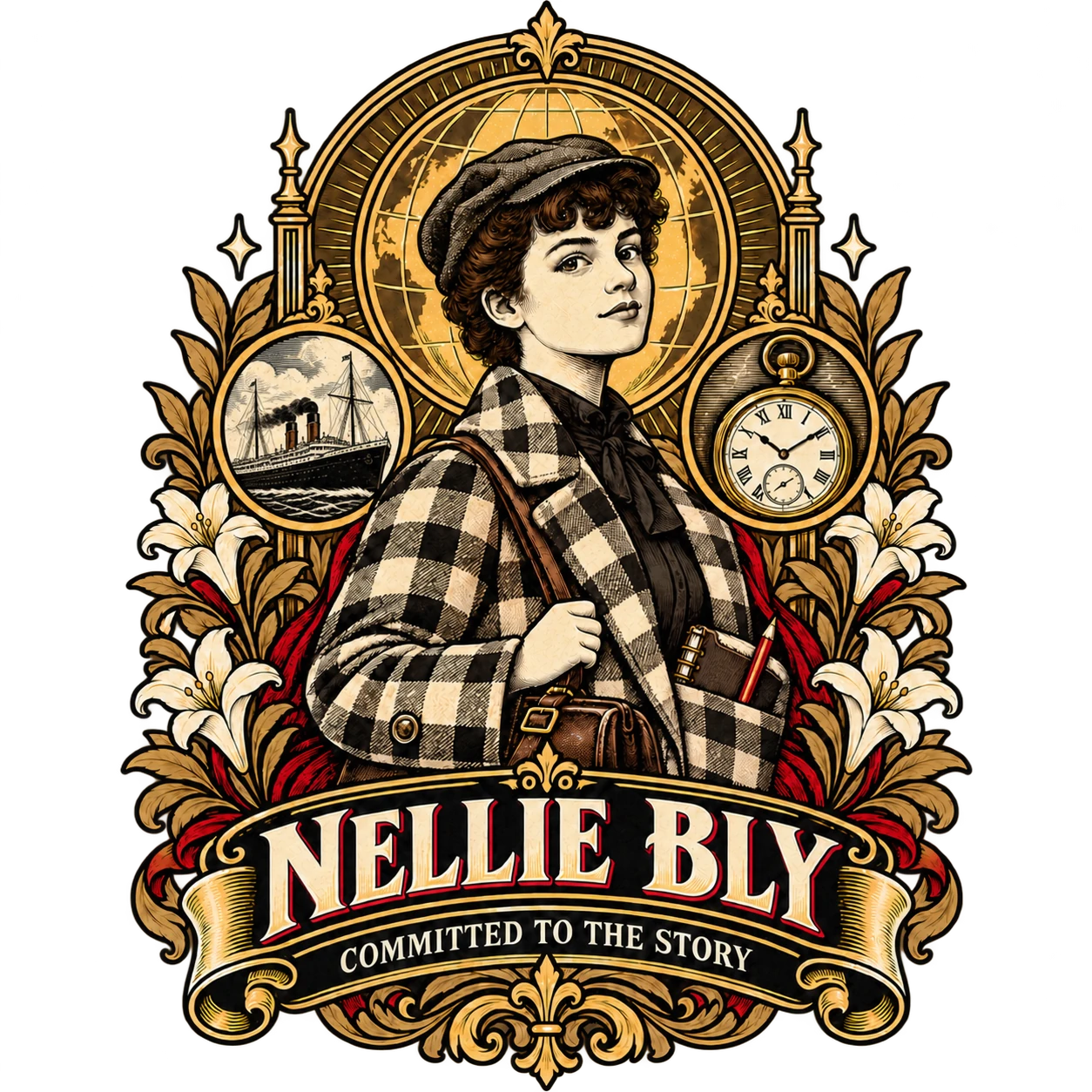
Portrait made with AI image tools from our own research and art direction.
In the portrait: The globe behind her head is her race around the world, seventy-two days in 1889 and 1890. The steamer and the pocket watch are how she did it, against the clock. The checked coat and the single small bag are what she took for the whole journey.
№ 012 · 1864–1922
Nellie Bly
Also known as Elizabeth Jane Cochran; Elizabeth Cochrane; Elizabeth Cochrane Seaman; Pink Cochran
In the Archive · Shirt coming soon
Nellie Bly got herself committed to a New York asylum to expose how it treated the women inside, then went around the world in seventy-two days, faster than anyone before her.
Remember her for this
Told she could not go around the world because a woman would need a protector and too much luggage, Nellie Bly said: “Start the man, and I’ll start the same day for some other newspaper and beat him.” A year later they sent her, with two days’ notice. She took one bag, and came home in seventy-two days.
Her story
In September 1887 a young woman sat up all night in a New York boarding house, staring into space. By morning the police had been called. That was the plan.
Within days a judge and doctors at Bellevue Hospital had pronounced her insane and sent her to the women’s asylum on Blackwell’s Island. She was Nellie Bly, twenty-three, and the New York World wanted “a plain and unvarnished narrative” of how its patients were treated.
She was born Elizabeth Jane Cochran in Pennsylvania in 1864. In 1885 the Pittsburg Dispatch ran a column called “What Girls Are Good For”. Not much, it concluded, outside the home. She wrote back in a fury, and the paper hired her.
When the Dispatch moved her to fashion and society, the usual beat for a woman, she went to Mexico, where the government jailed newspaper editors, and criticised it until it was unsafe to stay. Then she left a note: “I am off for New York. Look out for me. BLY.”
In the asylum she stopped pretending. “I talked and acted just as I do in ordinary life,” she wrote. “Yet strange to say, the more sanely I talked and acted the crazier I was thought to be.”
Women were scrubbed in ice-cold baths and had buckets of cold water thrown over their heads. They were fed spoiled beef. Nurses mocked and slapped them, and choked one woman until their finger marks showed on her throat all day.
Some, she was convinced, were no more insane than she was. Louise Schanz spoke only German, and a nurse who spoke German refused to translate for the doctor. She was, Bly wrote, “consigned to the asylum without a chance of making herself understood.” She was released after ten days, sorry, she wrote, that she could not take some of the others with her.
Her story made her famous, and a grand jury took her back to the island and called for more money, better staff and women doctors to supervise the nurses. Then she went undercover again: in a police cell, a crooked employment agency and a trade in newborn babies.
Next she set out to beat Phileas Fogg’s eighty days around the world. A woman, the business manager said, would need a protector and too much luggage. “No one but a man can do this.”
“Very well,” she said. “Start the man, and I’ll start the same day for some other newspaper and beat him.”
A year later her editor asked whether she could leave the day after next. “I can start this minute,” she said.
She sailed on 14 November 1889, met Jules Verne at Amiens and bought a monkey in Singapore. Her train reached Jersey City on 25 January 1890, seventy-two days, six hours and eleven minutes later, faster than anyone had gone around the world before. Her name went on board games, hats and lamps.
In 1895 she married Robert Seaman, a millionaire manufacturer about forty years older. When he died in 1904 she took over his Iron Clad Manufacturing Company, which made steel barrels, employed some 1,500 people at its height, and gave them health care and a library. Then men she trusted stole from the firm, and by 1911 it was in the bankruptcy courts.
In 1914, facing a contempt charge, she sailed for Vienna to raise money, just as the First World War broke out. She talked her way to the front, and her biographer, Brooke Kroeger, counts her the first woman to report from the Eastern Front.
She stayed on even after the United States went to war with Austria-Hungary in 1917, and became an admirer of Germany and Austria and a bitter enemy of Britain. In 1919 the Austrian government paid for her journey to Paris to lobby President Wilson. She never saw him. American Army intelligence questioned her instead, found her “aggressive and defiant” but loyal, and decided she would “do less harm in America than in France”. At home she was arrested on a perjury charge, and a lawsuit over the firm ended her relationship with her mother.
Arthur Brisbane gave her a column on the New York Evening Journal, where she found work for unmarried mothers and homes for babies. She died of pneumonia in 1922, aged fifty-seven, and Brisbane called her “the best reporter in America”.
The trouble with Nellie Bly
Nellie Bly would not stay on the fashion page, where newspapers put women. To expose the people who ran things behind closed doors, she went in herself, as a patient, a prisoner, a servant or a buyer, and wrote down what was done. Told that a woman would need a protector to cross the world, she went alone.
What the usual story gets wrong
-
“Her asylum exposé won an extra million dollars for the city’s patients.”
Verdict: Oversimplified
The million is her own claim, from the last page of Ten Days in a Mad-House. The department that ran New York’s asylums, hospitals and prisons had asked for a large increase on 5 October 1887, four days before her first article. After her story the mayor backed the full request, and so did the grand jury she went with to the island. In December the city granted $850,000 more, the biggest rise any department received, with about $50,000 of it set aside for the women’s asylum. Her biographer Brooke Kroeger calls the million a forgivable exaggeration: the money was coming, and her story gave the case real weight.
-
“She raced Elizabeth Bisland around the world.”
Verdict: Oversimplified
The newspapers made it a race; the two women did not set out as rivals. The Cosmopolitan sent Bisland west on the day Bly sailed east, after her editor talked her into going, and Bly heard about her only on the far side of the world, nearly six weeks in. Bly’s targets were Phileas Fogg’s eighty days and her own promise of seventy-five. She beat both, and reached home four days ahead of Bisland.
-
“She invented the 55-gallon oil drum.”
Verdict: Oversimplified
Her company, Iron Clad, made some of the first steel barrels in America, and she drove and sold them. But the barrel patents of 1905 name her factory superintendent, Henry Wehrhahn, as the inventor; he assigned them to Iron Clad and to her. The patents in her own name, both granted in 1902, are for a milk can and a stacking refuse can. How much of the barrel’s design was hers is still argued over.
-
“In 1913 she predicted that women would win the vote in 1920.”
Verdict: Oversimplified
She rode in the suffrage parade in Washington in March 1913 and reported it for the New York Evening Journal. Her report passes on a suffrage speaker’s plan rather than a prophecy of her own: “Every State in the Union will grant suffrage to women before 1919 except Vermont”, which would hold out until 1920. American women won the vote nationally in 1920, by constitutional amendment rather than state by state.
Sources & rabbit holes
The core evidence is her own newspaper series, written in the first person, and the books she made from them, Six Months in Mexico (1888), Ten Days in a Mad-House (1887) and Nellie Bly’s Book: Around the World in Seventy-Two Days (1890), in which she is both reporter and heroine. She left no archive of personal papers. Her life away from the page was pieced together by Brooke Kroeger, whose 1994 biography draws on some six hundred of her articles, court records, passport files, Army intelligence reports and about 130 letters. Earlier children’s biographies, partly fictionalised, are the source of many of the stories still told about her.
Primary sources
-
Ten Days in a Mad-House (opens in a new tab)
The whole exposé as she published it in book form, from the mirror rehearsals to the grand jury, with her undercover pieces on employment agencies and a paper-box factory at the end.
-
Nellie Bly’s Book: Around the World in Seventy-Two Days (opens in a new tab)
Her own account, from the business manager who said only a man could do it to the one hand-bag, the visit to Jules Verne and the monkey bought in Singapore.
-
Six Months in Mexico (opens in a new tab)
Her first book, from the trip she made with her mother at twenty-one, including her account of a government that jailed newspaper editors.
-
Milk-can, US Patent 697,553 (opens in a new tab)
One of the two patents granted in her married name in 1902, with the original drawings. The other is for a stacking refuse can.
Museums & archives
-
Nellie Bly: A Resource Guide (opens in a new tab)
Photographs, newspaper pages and her wartime dispatches from the Library’s collections, gathered in one place.
-
Nellie Bly of The New York World (opens in a new tab)
Her undercover pieces for the World from 1887 to 1889, with the original headlines and the newspaper reports that followed them.
Academic papers
-
Nellie Bly: She Did It All (opens in a new tab)
Her biographer on what the US National Archives revealed: the passport that hid her age, four years in wartime Vienna, and the Army intelligence officers who questioned her on the way home.
-
Nellie Bly Merchandise and the Changing American Woman: A Material Culture Study (opens in a new tab)
How her name and face sold hats, lamps and flowers after 1889, and what that says about the women who bought them.
Books
-
Nellie Bly: Daredevil, Reporter, Feminist (opens in a new tab)
The full biography, built from some six hundred of her articles, court papers and letters, and the source for her business and war years.
-
Eighty Days: Nellie Bly and Elizabeth Bisland’s History-Making Race Around the World (opens in a new tab)
The journey told from both sides, with Elizabeth Bisland of The Cosmopolitan heading west as Bly went east.
Watch
-
Around the World in 72 Days (opens in a new tab)
The documentary’s website, with a transcript, a map of her route and extracts from her book.
Listen
-
History’s Heroes: Nellie Bly Goes Undercover (opens in a new tab)
The asylum story told by a historian in under half an hour.
-
The Plucky Path of Nellie Bly (opens in a new tab)
Her biographer on the whole career, Pittsburgh to Vienna, with a full transcript.
Further reading
-
“Behind Asylum Bars”: Nellie Bly Reporting from Blackwell’s Island (opens in a new tab)
A Library of Congress reference librarian follows the asylum story through the newspapers of 1887, with links to the original pages.