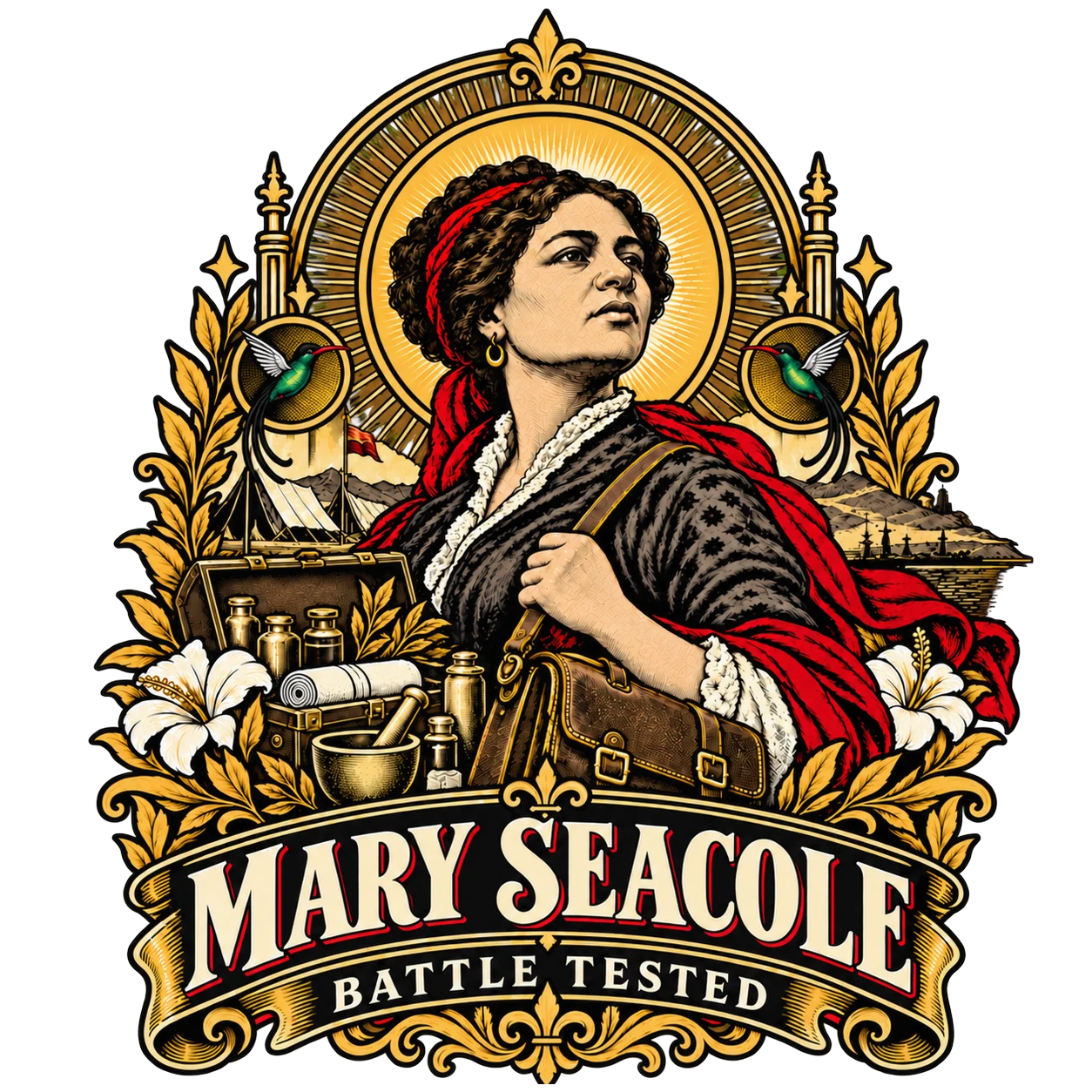
Portrait made with AI image tools from our own research and art direction.
In the portrait: The hummingbirds are doctor birds, Jamaica’s national bird, for the island where she was born and learned to heal. The chest holds the medicine and bandages she carried towards the fighting. The tents and the harbour are Balaklava, where she built the British Hotel.
№ 004 · 1805–1881
Mary Seacole
Also known as Mary Jane Seacole (née Grant); Mother Seacole
In the Archive · Shirt coming soon
Mary Seacole was turned away when she offered to nurse in the Crimean War, so she paid her own way there, opened a business near the front and made herself useful anyway.
Remember her for this
At a Fourth of July dinner in Panama, about twenty Americans drank to Mary Seacole for her work in a cholera outbreak, and their speaker added that they would bleach her if they could. She thanked them for drinking her health and declined the bleaching “without any thanks”. Then she drank to “the general reformation of American manners”.
Her story
Long before the Crimean War made her famous, Mary Seacole was in the habit of solving problems herself instead of waiting for somebody else to. She was born Mary Grant in Kingston, Jamaica, in 1805, into a household where care was practical work. Her mother ran a boarding house and was known as a healer, and Mary grew up learning to treat illness, look after people and run a business.
Those skills travelled with her. She crossed the Atlantic, worked in business, spent time in Central America and faced outbreaks of serious disease. Her medicine came from experience and observation, from the practice she inherited and from years of solving problems wherever she found them, rather than from any one neat professional qualification.
Then Europe went to war in the Crimea. Mary was in London on business when reports from the front began to describe terrible conditions for British troops. Nurses were being recruited, and she tried to join the official effort. She was turned away.
Mary was less interested in being accepted than in getting there. With her business partner, Thomas Day, she paid for her own journey east, and near Balaklava she set up the British Hotel. The name makes it sound grander and tidier than it was. It was part business, part supply depot, part canteen, part social space and part base for her medical work. Soldiers bought food and supplies there, officers came to rest, and Mary treated illness and injury. Contemporary accounts describe her heading towards the fighting with bandages, medicine and provisions for wounded men.
Her strength was competence under pressure, which is harder to romanticise than heroism because it looks like work. She sourced stock, balanced costs, travelled through dangerous country, treated the sick and wounded and improvised her way through a great deal of chaos.
These days people like to stand Seacole beside Florence Nightingale and ask which of them deserves the larger statue. It is a bad question. Nightingale’s influence on nursing reform is real, and so is the independent work Seacole did. Seacole was Jamaican, mixed-race, entrepreneurial, proud and ambitious, and she will not fit neatly inside one professional label.
When the war ended, the British Hotel suddenly lost the enormous customer base the army had created, and Mary came back to Britain bankrupt. People who knew her work raised money to support her, and her reputation lasted among veterans and the public.
She was also willing to talk about her own achievements. Women’s history is full of people whose work survived only because somebody else decided to record it. Mary Seacole wrote her own book. Wonderful Adventures of Mrs Seacole in Many Lands came out in 1857 and sold well, and the woman in it is funny, confident, observant and entirely unwilling to shrink herself into a supporting role.
The trouble with Mary Seacole
Mary would not let an institution’s refusal decide what she could contribute. She made her own route to the front out of independence, practical skill and sheer persistence. She did it as an entrepreneur, paying for herself, travelling independently and building what she needed instead of waiting for official permission.
What the usual story gets wrong
-
“Mary Seacole was the Black Florence Nightingale.”
Verdict: Oversimplified
The comparison flattens both women and makes Seacole’s importance dependent on proximity to somebody else.
-
“Florence Nightingale personally turned her away.”
Verdict: False
When Seacole applied, Nightingale had already left for the Crimea. The War Office, the Quartermaster-General’s department and the Medical Department turned her away; so did the women recruiting the next party of nurses, including one of Nightingale’s companions, who said the places were filled; so did the Crimean Fund. Seacole later asked herself whether “American prejudices against colour had some root here”.
-
“She was a nurse who ran a hospital in the Crimea.”
Verdict: Oversimplified
She was a healer, entrepreneur, traveller and writer as well as a nurse in the broad historical sense. The British Hotel worked as a business, canteen, club and base for her care work, rather than as a conventional hospital.
-
“She just ran a shop for officers. Her nursing is a modern myth.”
Verdict: False
The Times correspondent who saw her at work says otherwise. William Howard Russell wrote that she “doctors and cures all manner of men with extraordinary success”. In his preface to her 1857 book he called her “one who nursed her sick, who sought out her wounded to aid and succour them”. The British Hotel was a business, and her own book says so. Historians still argue about how large and how skilled her medical work was; whether it happened is settled.
-
“The medals in her 1869 portrait were official British awards for her war service.”
Verdict: Little evidence
There is little evidence that they were. The National Portrait Gallery thinks she probably bought them to signal her involvement in the war, and identifies the gold star as the Turkish Order of the Mejidie, which press reports at the time said the Ottoman government had given her.
Sources & rabbit holes
The core evidence is her own book, Wonderful Adventures of Mrs Seacole in Many Lands (1857), with William Howard Russell’s reports from the Crimea and the testimonials she printed in it. For long stretches of her life, including the refusals in London, her account is the main source, and the precise reasons she was turned down cannot now be recovered. How much of her Crimean work was medical, and how far it influenced nursing, is still argued over: Lynn McDonald makes the sceptical case, and Helen Rappaport’s 2022 biography is a long attempt to separate the record from the legend.
Primary sources
-
Wonderful Adventures of Mrs. Seacole in Many Lands (opens in a new tab)
Her own account, from Kingston to Balaklava. Chapter VIII is her version of the refusals in London, including the night she wondered whether her colour had played a part.
Museums & archives
-
Mary Seacole, oil on panel (opens in a new tab)
The only known oil painting of her, rediscovered in 2002 behind a print bought at a local sale.
-
Mary Jane Seacole (née Grant) (opens in a new tab)
The gallery’s short biography, with all three of its portraits of her, including Count Gleichen’s 1871 terracotta bust.
Academic papers
-
Mary Seacole and the Virtual Nation (opens in a new tab)
Open access. On her years in Panama before the war, when she ran a British Hotel for American customers and made a point of being British among them. Lee reads the Fourth of July dinner at her brother’s hotel as the moment she rejected American citizenship as firmly as she rejected the bleaching.
-
Mary Seacole and claims of evidence-based practice and global influence (opens in a new tab)
Open access. The sceptical case, from the editor of Florence Nightingale’s collected works: that Seacole was mainly a businesswoman serving officers, and that claims for her influence on nursing do not hold. Read it alongside Rappaport.
Books
-
In Search of Mary Seacole: The Making of a Cultural Icon (opens in a new tab)
By the historian who identified the lost 1869 portrait. Almost twenty years of research, sorting what is documented from what has grown up around her.
Watch
-
History of Nursing Lecture 2023: Mary Seacole as Doctress, Nurse and Caregiver (opens in a new tab)
Free to watch, about fifty minutes: Rappaport on Seacole’s medical work, drawing on the book.
Listen
-
You’re Dead to Me: Mary Seacole (opens in a new tab)
A comedy history podcast with a historian on the panel: her childhood healing, Panama, cholera, the racists she dealt with and the risks of running a business in a war zone.
Further reading
-
Mary Seacole by Albert Charles Challen (opens in a new tab)
Written for teachers and pupils: how to read the portrait, who she was, and how she was almost erased from British history after she died.