Portrait made with AI image tools from our own research and art direction.
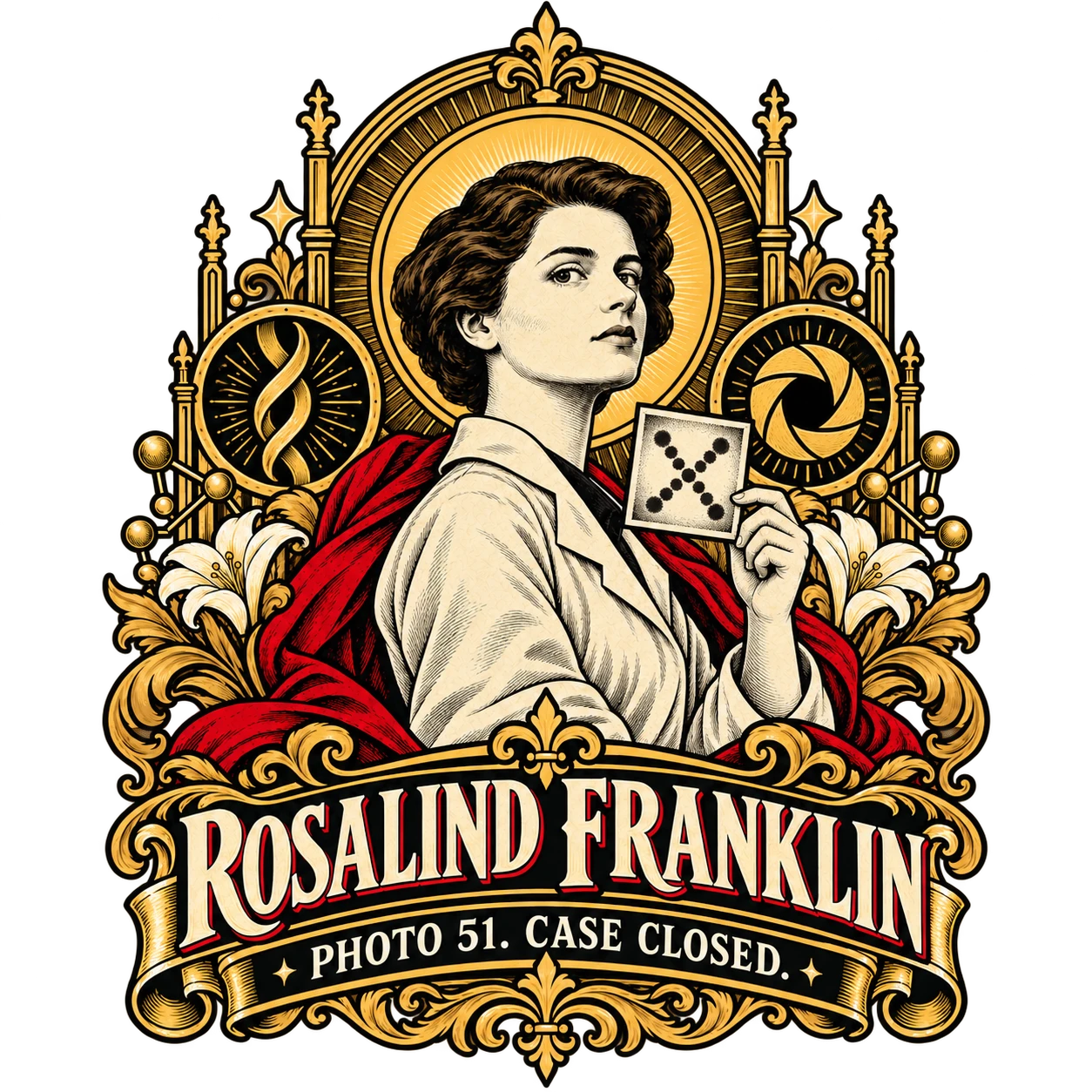
In the portrait: She holds a square of X-ray film marked with an X of dots, the kind of pattern that reveals a helix. It is a simplified echo of Photograph 51 rather than the photograph itself. The camera aperture stands for the X-ray cameras behind her work, and the two twisting ribbons for the double helix her evidence helped to reveal.
№ 008 · 1920–1958
Dr Rosalind Franklin
Also known as Rosalind Elsie Franklin
In the Archive · Shirt coming soon
Rosalind Franklin’s experiments gave some of the clearest evidence of DNA’s shape, including Photograph 51, but she worked in a research culture that did not always treat her data, or her say over it, with the respect it deserved.
Remember her for this
In May 1952, Franklin and Raymond Gosling set up their X-ray camera on a Friday and developed the film the following Tuesday. In between, the DNA sat in the beam for 62 hours. The picture became famous; the hours are written in her lab notebook.
Her story
Rosalind Franklin’s discovery arrived as a faint pattern on photographic film after more than two days of exposure. Photograph 51 is dark and grainy, marked with an X-shaped pattern of blurred spots, and to most people it does not immediately look like the answer to anything. Franklin read it as evidence.
Franklin was born in London in 1920 and trained in natural sciences at Cambridge. Before DNA made her famous, she had already built a serious scientific career studying the structure of carbon and coal. Later, in Paris, she became highly skilled in X-ray diffraction, a demanding technique in which scientists work out a molecule’s structure from the patterns X-rays make when they scatter through a sample.
The work was meticulous. Samples had to be prepared correctly, conditions controlled, exposures given the time they needed and results interpreted with discipline, and confidence was no substitute for data. Franklin was very good at it.
In 1951 she joined King’s College London to work on DNA fibres. Working with PhD student Raymond Gosling, she carefully investigated how hydration changed the fibres and helped distinguish two forms of DNA, known as A and B.
In May 1952, Franklin and Gosling exposed a B-form DNA sample to X-rays for 62 hours, and the result became Photograph 51. The image was unusually clear. Its characteristic X-shaped diffraction pattern strongly suggested a helix, and it also held information about the molecule’s dimensions. Getting it took expertise (the right sample, conditions and technique) and the patience to keep refining the experiment until the structure began to reveal itself.
Maurice Wilkins, Franklin’s colleague at King’s, showed Photograph 51 to James Watson without her agreement or knowledge. Other data from Franklin’s work also reached Watson and Francis Crick through institutional channels. Watson and Crick were building physical models of DNA at Cambridge, and Franklin’s experimental results gave them constraints that the model they eventually proposed had to fit.
In April 1953, Nature published three papers together: Watson and Crick’s double-helix model, work from Wilkins and colleagues, and Franklin and Gosling’s experimental paper.
Popular history later flattened all this into a simple morality play in which two men stole one woman’s photograph and won the discovery. It was more complicated than that, and Franklin does not need the simple version. Discoveries rarely come down to one photograph or one person. Watson and Crick’s model building mattered, and so did other researchers’ chemistry and Wilkins’s work. Franklin’s data mattered enormously.
The ethical problem is real all the same. For decades, the public story of DNA gave far more space to the famous model than to the experimental precision that helped make it possible.
The argument over credit also tends to lose Franklin herself. She left King’s for Birkbeck College, where she built a productive research programme studying viruses. Her work on tobacco mosaic virus and other structures helped advance the emerging field of structural virology. Colleagues respected her ability, and she was leading important science in her own right.
Cancer cut the work short. Rosalind Franklin died in 1958, at thirty-seven. It is deeply unfair how little time she had, but pity is the wrong way to remember her.
Her great strength was exactness, and the answer she wanted was the true one. She learned difficult techniques well enough to make invisible structures visible, kept improving her experiments, separated what the data showed from what people hoped it would show, and built arguments sturdy enough to survive other people’s opinions. Hers was the kind of persistence that checks it again, refines the sample, waits another hour, measures properly and lets the evidence become undeniable.
One image does not settle every argument about the discovery of DNA. Put Franklin’s work back in the story, though, and the case for her brilliance is one you can measure.
The trouble with Rosalind Franklin
Franklin expected first-rate scientific work to be treated as first-rate, whoever produced it. Her story runs through scientific hierarchy, gendered workplace culture and the ownership of data, and her evidence helped make a famous discovery while she stayed outside the most celebrated version of it.
What the usual story gets wrong
-
“Watson and Crick stole Photo 51 and solved DNA with it.”
Verdict: Oversimplified
Photograph 51 was important, but the double-helix story involved multiple researchers, experimental datasets and model building. How much the photograph itself mattered to Watson and Crick is still argued over: King’s College London calls its role crucial, while Matthew Cobb and Nathaniel Comfort, drawing on Crick’s own notes and recollections, argue that an informal report on the King’s laboratory’s research mattered more. The ethical problem is nevertheless real: King’s College London states that Maurice Wilkins showed Photograph 51 to James Watson without Franklin’s agreement or knowledge. Franklin’s experimental work gave Watson and Crick vital information.
-
“She never understood what her own photograph showed.”
Verdict: False
Her own draft says otherwise. Unaware that Watson and Crick were building a model, Franklin went back to Photograph 51 in early 1953 and in March drafted a paper arguing that a helical structure was “highly probable”: most likely two chains, ten bases to each turn, with the bases inside and the phosphates outside. The story that she sat on the image without grasping it traces back to James Watson’s 1968 memoir, The Double Helix.
-
“She took Photo 51 on her own.”
Verdict: False
Photograph 51 was produced by Franklin together with her PhD student Raymond Gosling.
-
“The Nobel committee passed her over because she was a woman.”
Verdict: False
The dates rule it out. Watson, Crick and Wilkins shared the Nobel Prize in Physiology or Medicine in 1962, four years after Franklin died. Nobody can be nominated for a Nobel Prize after their death, and under the rules of the time a prize could go to someone who had died only if they had been nominated before 1 February of the year it was awarded. A prize can also be shared by no more than three people, so whether she would have been included had she lived is something nobody can know.
-
“DNA was her only important work.”
Verdict: False
Her work on carbon and especially her later structural virology research were substantial scientific contributions.
Sources & rabbit holes
The core evidence is her own: the 1953 Nature paper with Gosling; her laboratory notebooks, drafts and letters at the Churchill Archives Centre in Cambridge; and the further notes, prints and letters acquired in 2025 by the Science History Institute in Philadelphia. James Watson’s 1968 memoir The Double Helix set the popular picture of her, and even accounts written in her defence often repeat its framing.
Primary sources
-
Mock D.N.A. Helix Funeral Invitation (opens in a new tab)
A joke death notice for the DNA helix that she and Gosling wrote in July 1952 to tease Maurice Wilkins; by March 1953 her own analysis had brought the helix back.
-
DNA X-ray diffraction image known as Photo 51, annotated by Rosalind Franklin and Aaron Klug (opens in a new tab)
Her own print of the photograph, labelled “NaDNA ‘Structure B’” on the back in her handwriting, beside a 1968 note by Aaron Klug confirming it.
-
From Macromolecules to Biological Assemblies (opens in a new tab)
Klug’s Nobel lecture credits her with starting him on viruses at Birkbeck, and says that had she lived she “might well have stood in this place” before him.
Museums & archives
-
History of Molecular Biology Collection (opens in a new tab)
The archive that acquired the largest collection of her papers outside the UK in 2025, including her notes, prints and laboratory equipment.
-
The Papers of Rosalind Franklin (opens in a new tab)
The catalogue of her scientific papers, from the DNA notebooks to the virus work at Birkbeck, in the digitised copy Wellcome holds; the originals are at the Churchill Archives Centre in Cambridge. One slip: its biographical note dates her death to 20 March 1958, but she died on 16 April.
Books
-
Rosalind Franklin: The Dark Lady of DNA (opens in a new tab)
A full-length biography that covers her coal and virus work as well as DNA, and her life outside the laboratory, without casting her as a victim.
Watch
-
Raymond Gosling on Working on DNA with Rosalind Franklin (opens in a new tab)
The student who made Photograph 51 with her, recorded in 2003 with a transcript on the page, on how she was recruited to King’s and why he thought Watson had her wrong.
Listen
-
In Our Time: Rosalind Franklin (opens in a new tab)
A historian and two scientists on her whole career, coal and viruses included, not only the photograph.
Further reading
-
The story behind Photograph 51 (opens in a new tab)
A King’s professor of molecular biophysics shows how to read the photograph, and how close her March 1953 draft came to the structure.
-
What Rosalind Franklin truly contributed to the discovery of DNA’s structure (opens in a new tab)
Free to read. Biographers of Crick and Watson went through her notes together and argue she was an equal contributor to solving the structure, not its victim.