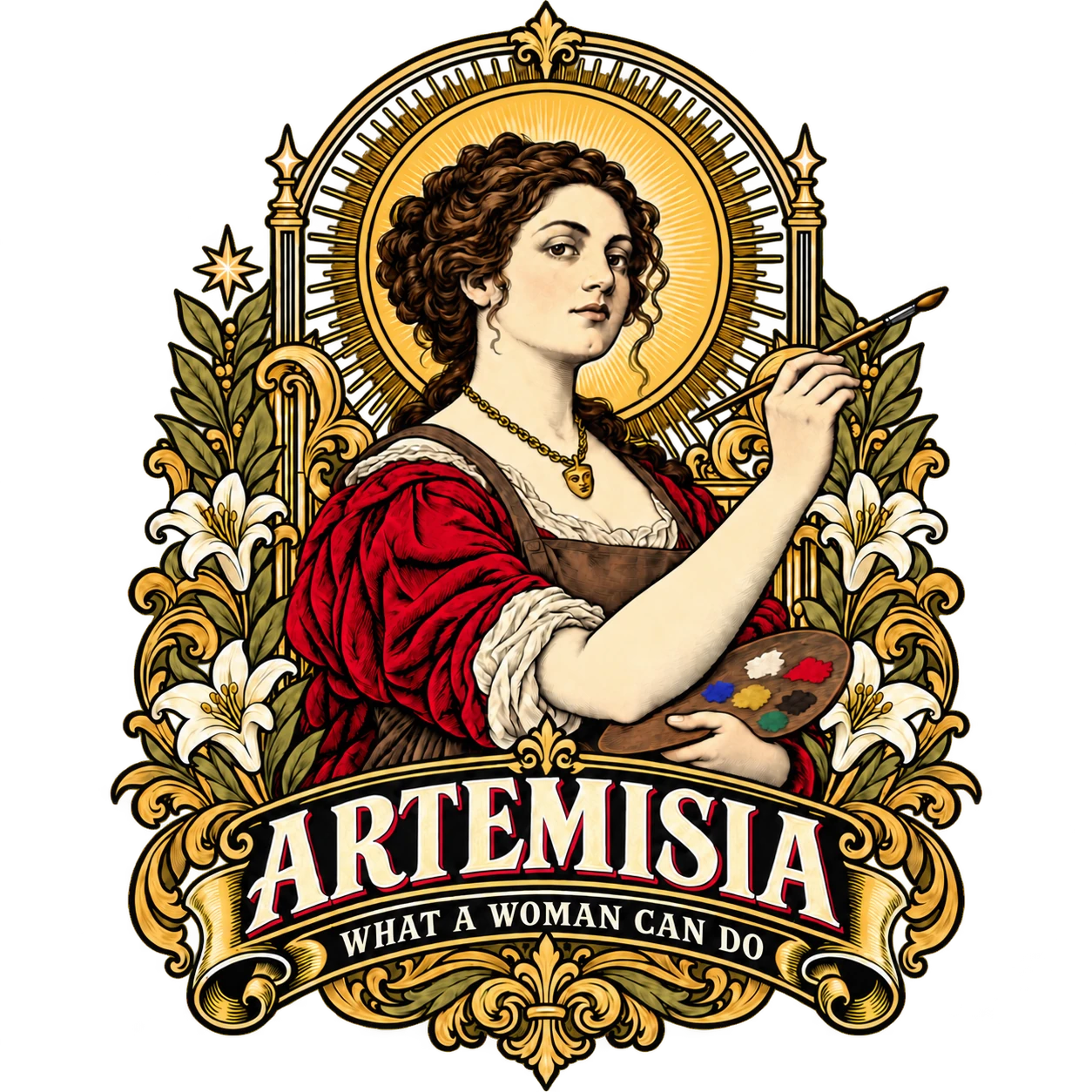

Remember her for this
On the last day of 1625, a French artist in Rome drew a portrait of Artemisia’s hand, holding a fine brush. Across the top he wrote whose it was, ‘the excellent and skilful Artemisia’. On the back he wrote that it was a thousand times worthier than the hands of the dawn goddess, because it could make marvels.
Her story
Artemisia Gentileschi was the most celebrated woman painter of seventeenth-century Europe. She ran her own studio, named her own prices and painted for the Medici, Charles I and the King of Spain.
In 1649, a painter in Naples was arguing about money with a collector in Sicily. She defended her price. With her, she told Antonio Ruffo, he would not lose: “you will find the spirit of Caesar in the soul of a woman.”
A woman’s name, she wrote, “raises doubts until her work is seen.” Her paintings “will speak for themselves.” By then Artemisia Gentileschi had been letting the work speak for almost forty years.
She was born in Rome in 1593, the only daughter of the painter Orazio Gentileschi, one of the first followers of Caravaggio, and she learned the trade in his workshop.
By 1610, still in her teens, she had signed and dated her first known painting, Susanna and the Elders: the story of a young woman spied on and threatened by two older men, told from Susanna’s side. In 1612 her father would tell the Grand Duchess of Tuscany that his daughter had “no peers”.
In 1611 she was raped by Agostino Tassi, a landscape painter who worked with her father. She was seventeen.
Orazio took Tassi to court in 1612. The court tested her testimony by torture, tightening cords around her fingers. Her answer is in the record: “I have told the truth and I always will, because it is true and I am here to confirm it wherever necessary.” Tassi was convicted and banished from Rome, but the sentence was never enforced.
That November she married a Florentine, Pierantonio Stiattesi, and early the next year she left Rome for Florence, where she made her name.
The Medici became her patrons. In 1615–16 Michelangelo Buonarroti the Younger paid her 34 florins for a ceiling allegory in his family’s house, far more than the men working on the same scheme.
On 19 July 1616 she was admitted to Florence’s Accademia delle Arti del Disegno, the first woman to join it. At the trial she had barely been able to read and could not write. In Florence she taught herself both.
She painted herself again and again, as a lute player, as a martyr and as Saint Catherine of Alexandria, and each one was both a portrait and an advertisement.
For Grand Duke Cosimo II she painted Judith Beheading Holofernes: Judith holding the Assyrian general down by the hair, the sword already in his neck. It was refused a place in the Grand Duke’s gallery, and she needed her friend Galileo Galilei to intercede before she was paid.
In 1620 she went back to Rome, leaving debts in Florence, and in the late 1620s she worked in Venice. A portrait print of about 1628 called her, simply, Famosissima Pittrice: most famous woman painter.
By 1630 she had settled in Naples, then ruled by Spain. She ran a busy studio, with her daughter Prudenzia, her only surviving child, working beside her. With Massimo Stanzione she painted a cycle on the life of John the Baptist for the King of Spain’s Buen Retiro palace in Madrid.
In 1638 Charles I invited her to London, where her father had been working since 1626. Father and daughter worked side by side at court. Orazio died in 1639.
The standard handbook for artists, Cesare Ripa’s Iconologia, described Painting as a woman: full black hair, dishevelled, a gold chain at her throat with a mask hanging from it. Men who painted Painting had to paint someone else. Artemisia, probably in London, painted herself.
She shows herself at work, sleeve rolled back, the gold chain and mask at her throat, too intent on the canvas to look at us. It is in the Royal Collection still.
By 1640 she was back in Naples. The letters to Ruffo come from her last years. In one she promised him: “I will show Your Illustrious Lordship what a woman can do.”
A document places her alive in Naples in August 1654. Nobody knows when she died.
For two centuries her name faded and her paintings were catalogued as other people’s work, and they are still coming home. A self-portrait as Saint Catherine surfaced at a Paris auction in 2017 and now hangs in the National Gallery in London. A Susanna that Charles I had owned was identified as hers and went on show at Windsor Castle in 2023.
The trouble with Artemisia Gentileschi
Artemisia took the subjects her century treated as men’s work, huge canvases of history and scripture, and made the women in them the ones who act. She joined an academy no woman had joined before her, ran her own studio, chased her fees through grand dukes and astronomers, and told a doubting collector that a woman’s name raised doubts only until her work was seen. Then she made sure it was seen, for nearly forty years.
What the usual story gets wrong
-
“Her Judith paintings were her revenge on the man who raped her.”
Verdict: Disputed
It is the most popular reading of her work, and it is an interpretation, not a record. Her first Judith Beheading Holofernes dates from around the time of the 1612 trial, and feminist art historians, Mary Garrard among them, have read her Judiths as a punishment of Tassi in paint. But Judith was one of the favourite heroines of the age, painted by her own father among many others, and the Uffizi version was a commission from the Grand Duke of Tuscany. The National Gallery calls the link ‘debatable’. The curator of its 2020 exhibition, Letizia Treves, points instead to a young painter choosing subjects and compositions that would make her stand out.
-
“She was the first professional woman painter, or the only one of her time.”
Verdict: False
She had predecessors and rivals. Sofonisba Anguissola, born some sixty years before her, was a court artist; Lavinia Fontana was honoured with a portrait medal that showed her on one side and Painting on the other; Fede Galizia, Giovanna Garzoni and, later, Elisabetta Sirani built careers too. A 2021–22 exhibition in Hartford and Detroit gathered nearly sixty works by women artists in Italy between 1500 and 1800. Artemisia stood out for choosing large history paintings of heroines and violence, ground her century treated as men’s.
-
“History forgot her until feminist art historians rediscovered her in the 1970s.”
Verdict: Oversimplified
In her lifetime she was famous: a print of about 1628 calls her Famosissima Pittrice, and Charles I collected her work. After her death she did fade, for two centuries, and her pictures were catalogued under other names; one of Charles I’s spent more than a hundred years in store at Hampton Court labelled ‘French School’. The recovery began in 1916, when the Italian scholar Roberto Longhi wrote about her and her father. Feminist art history from the 1970s onward, above all Mary Garrard’s 1989 book, made her famous again, and the rediscoveries have not stopped.
-
“Agostino Tassi taught her to paint.”
Verdict: False
Her father trained her in his workshop, and she had signed and dated Susanna and the Elders in 1610, before Tassi was brought in. Orazio hired him, a landscape painter, in 1611 to teach her perspective, and Mary Garrard has said he never taught her anything that showed up in her art. The 1997 film Artemisia made him her teacher and her lover; it was advertised in the United States as ‘The Untold True Story of an Extraordinary Woman’ until protests led by Garrard and Gloria Steinem had the line dropped.
Sources & rabbit holes
The core evidence is her own: her signed paintings; her testimony in the record of the 1612 trial, kept in the Archivio di Stato di Roma; and her letters, from the love letters to Francesco Maria Maringhi found in 2011 in the Frescobaldi family archive in Florence to the business letters from Naples to Cassiano dal Pozzo, Galileo and Antonio Ruffo, many of which survive only in later copies. Drawings, prints and royal inventories record how famous she was in her lifetime. Scholars and museums still differ over the dates of many paintings, and new works keep being found. Since the 1970s her art has often been read through her biography, and how far to do so remains the main argument about her.
Primary sources
-
Right hand of Artemisia Gentileschi holding a brush (opens in a new tab)
Black and red chalk. The inscription across the top names ‘the excellent and skilful Artemisia’; the one on the back ranks her hand above the hands of the goddess of dawn.
-
Artemisia Gentileschi Romana Famosissima Pittrice (opens in a new tab)
Her portrait as her own century framed it: an oval, a title and a banner whose Latin calls her a miracle of painting, easier to envy than to imitate.
-
Letter to Cassiano dal Pozzo (opens in a new tab)
Written from Naples on 31 August 1630. She asks her Roman patron for permission for her assistant to carry arms, and promises to send ‘my portrait, which you once requested’.
Museums & archives
-
Self-Portrait as the Allegory of Painting (La Pittura) (opens in a new tab)
The catalogue entry quotes Ripa’s description of Painting, which she turned into a self-portrait, and follows the picture through Charles I’s collection.
-
Self Portrait as Saint Catherine of Alexandria (opens in a new tab)
Unknown to scholars until it was sold at auction in Paris in 2017; the Gallery bought it the next year. The page includes a detailed audio description.
-
Judith Beheading Holofernes (opens in a new tab)
The Uffizi’s account of the painting that was refused a place in the Grand Duke’s gallery, and of the fee she collected only with Galileo’s help.
-
Artemisia UpClose: Artemisia in the Museum of Michelangelo (opens in a new tab)
The house museum that holds her ceiling allegory for Michelangelo Buonarroti the Younger, with the records of her fee and her admission to the Accademia on 19 July 1616.
Academic papers
-
Artemisia Gentileschi’s Self-Portrait as the Allegory of Painting (opens in a new tab)
On the tradition of Painting as a woman, and what it meant for a woman painter to take the part herself. Free to read from American University’s repository.
Books
-
Artemisia Gentileschi: The Image of the Female Hero in Italian Baroque Art (opens in a new tab)
The first full-length study of her life and work, with the trial record translated in an appendix.
-
Orazio and Artemisia Gentileschi (opens in a new tab)
The catalogue of the first exhibition of father and daughter together, with newly published trial documents and an inventory of her household goods. Free to download.
-
Lives of Artemisia Gentileschi (opens in a new tab)
Her letters, testimony from the trial and the earliest accounts of her life in one short book, several of them in English for the first time.
Watch
-
Artemisia in London (opens in a new tab)
A short film from the 2020 exhibition on her invitation to Charles I’s court and the self-portrait it produced.
Listen
-
Artemisia and Frida: great art, turbulent lives (opens in a new tab)
A tour of the National Gallery’s 2020 exhibition with its curator. The second half of the episode is about Frida Kahlo.
Further reading
-
Artemisia in her own words (opens in a new tab)
The exhibition’s curator on her voice: the trial, the love letters found in 2011 and the business letters from Naples.