
Remember her for this
Under the centre of Colchester lies a red and black layer, up to half a metre thick: what was left of the Roman colony after Boudica’s revolt in AD 60–61. None of her own words survive. What she did is still there, under the shops.
Her story
When Roman rule went from greed to open violence, Boudica turned local anger into a revolt that burned three Roman towns and made the empire rethink how it ran Britain.
Boudica reached the point at which being told to ‘put up with it’ stops working, and the result was a rebellion that set Roman cities on fire. She was queen of the Iceni, a people living in what is now East Anglia. Britain had been invaded by Rome less than twenty years earlier, and the Iceni existed in an uneasy relationship with the new imperial power. Her husband, Prasutagus, had managed an accommodation with Rome. When he died, that arrangement collapsed.
The surviving version of what happened next comes from Roman writers, not from Boudica or the Iceni themselves, and should be read with that in mind. Even so, the picture Tacitus gives is brutal. Roman officials treated the kingdom and its wealth as theirs to take; Boudica was flogged; her daughters were sexually assaulted. Around them, resentment was already building over land, debt and the arrogance of occupation.
Rome appears to have expected the usual submission. Instead, Boudica found allies. The Iceni joined with the neighbouring Trinovantes and other groups who had their own reasons to hate Roman rule, and the result was a military uprising on a scale that terrified Roman Britain.
Camulodunum (modern Colchester) came first. It was a Roman colony and a visible symbol of conquest, privilege and land taken for veteran settlers, and the rebels destroyed it. Londinium was next. The Roman governor Suetonius Paulinus decided he could not defend the settlement and withdrew, and London burned. Verulamium, near modern St Albans, was also attacked and destroyed. For a moment, the balance of power looked very different.
That moment is why Boudica survives so vividly in the imagination. She stands for the instant an apparently permanent system discovers that the people beneath it have a breaking point. Rome had professional armies, roads, taxation, administration and the prestige of an empire stretching across continents; Boudica had a coalition of people who had decided that the terms were no longer acceptable.
None of that makes the revolt simple or clean. Ancient warfare was savage, and Roman accounts describe enormous loss of life, including civilians, though their casualty figures are open to doubt. Boudica’s rebellion was audacious without being a modern liberation movement.
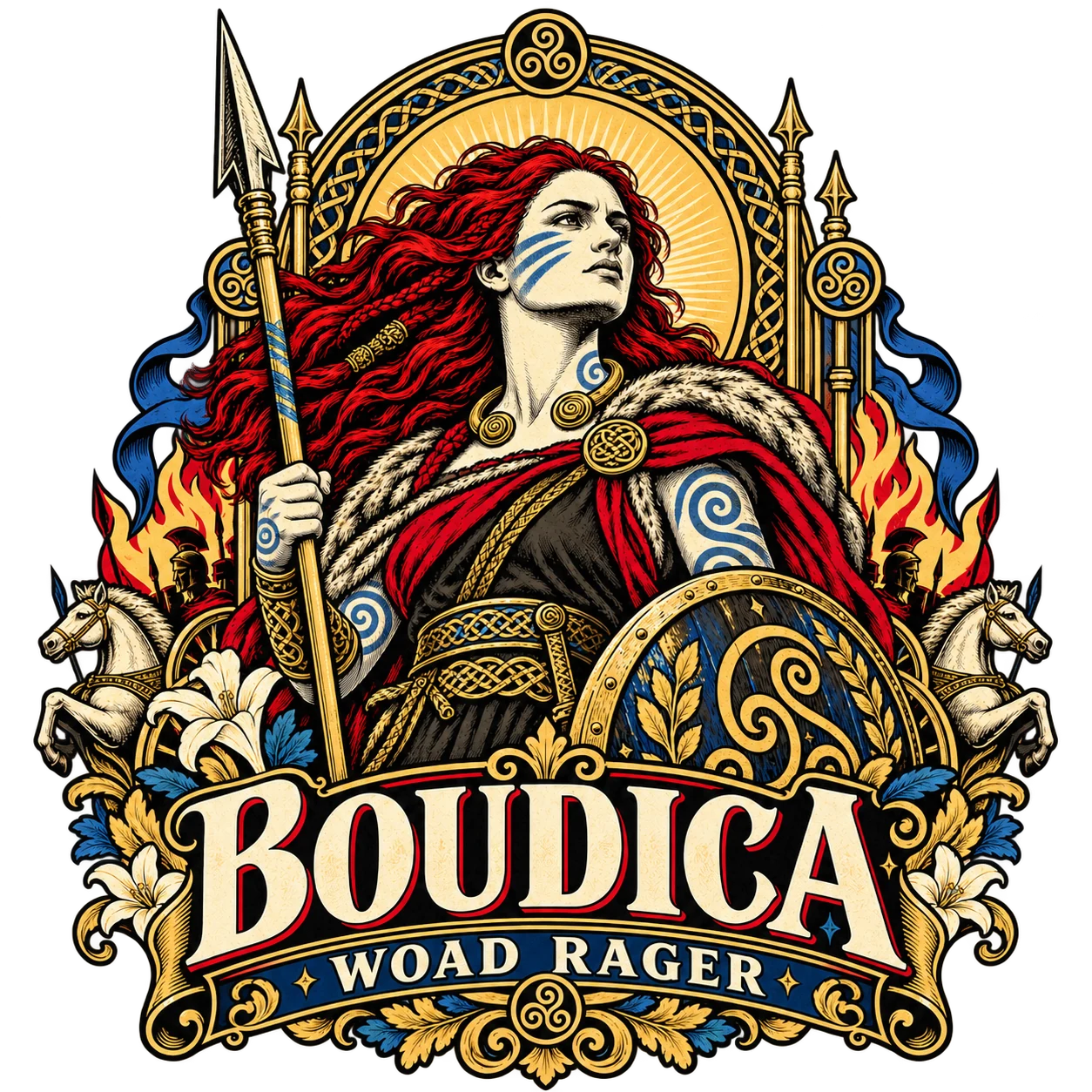
Nobody knows whether Boudica painted herself blue. The ‘woad warrior’ image is part of the later mythology around ancient Britons, and nothing reliable records it of Boudica herself. The portrait on her shirt winks at that legend, but the evidence stops short of it, so treat the woad as optional.
The evidence supports something better than the costume. A woman led a coalition against one of history’s most formidable imperial machines. Her forces devastated three major Roman settlements, and the province’s Roman administration was forced to confront what its own violence and extraction had produced.
Boudica’s forces were eventually defeated by the Roman army under Suetonius. After that, even the ancient writers disagree about her fate. Tacitus says she took poison; Cassius Dio says she fell ill and died. Her own voice did not survive, and no reliable contemporary portrait tells us what she looked like, so every generation has built its own Boudica. Victorian Britain made her an imperial national heroine, which is an odd honour for a woman famous for trying to throw an empire out of Britain.
Underneath all those versions is a woman pushed into a position where the people with overwhelming power assumed she had no meaningful choices left. She found one they had not planned for. She organised anger, built alliances, and turned personal humiliation and political grievance into collective action. She lost the final battle, but nearly two thousand years later the empire that defeated her still cannot tell the story of Roman Britain without saying her name.
The trouble with Boudica
Boudica lived under a Rome that expected obedience because it was Rome. Her revolt grew out of the way Rome ran the province: taxation, confiscation, military occupation, debt and the assumption that provincial elites would submit whenever Roman agreements stopped being convenient. Instead of enduring the abuse quietly, she answered it with organised resistance powerful enough to shake an empire’s confidence in its own province.
What the usual story gets wrong
-
“We know what she looked like.”
Verdict: Little evidence
There is no reliable contemporary portrait of Boudica. Cassius Dio’s famous description, very tall with tawny hair to her hips, a fierce glare and a harsh voice, was written long after the revolt and is no eyewitness portrait. The scythed chariot, wild red hair, blue face paint and fantasy-Celtic armour come from later cultural memory, including the Victorian statue at Westminster.
-
“Boudica is more legend than history.”
Verdict: False
The record is firm on the essentials: an Iceni leader headed a major anti-Roman uprising in AD 60–61; Colchester, London and St Albans were destroyed; and Roman accounts connect the revolt to confiscation, debt, humiliation and violence against Boudica’s family.
-
“She is buried under a platform at King’s Cross station.”
Verdict: Little evidence
The rumour cannot even agree on which platform: 8, 9 or 10. No trace of her has been found there or anywhere else, and nobody knows for certain where she died or where her last battle was fought. London has a second folk grave for her too: a Bronze Age burial mound on Parliament Hill, built more than a thousand years before she was born.
Sources & rabbit holes
The only ancient writers who tell Boudica’s own story are two Roman historians, Tacitus and Cassius Dio. Neither was an eyewitness: Tacitus was a child at the time and wrote decades later, and Dio’s account, written more than a century later, survives only as a later summary. The speeches both give her are their own compositions, not records of what she said. Archaeology confirms the destruction at Colchester, but it cannot tell us what she looked like or how she died, and it has not yet found where the last battle was fought.
Primary sources
-
Annals, Book XIV, chapters 29–39 (opens in a new tab)
The more detailed narrative of events, from the attack on Anglesey and Prasutagus’s will to the governor’s removal on a pretext. The speech he gives Boudica before the battle is his own composition.
-
Roman History, Epitome of Book 62 (opens in a new tab)
This is where the tall woman with tawny hair to her hips, a great gold necklace and a spear comes from.
Museums & archives
-
Tomb of Gaius Julius Alpinus Classicianus (opens in a new tab)
Part of the tomb of the finance official Rome sent in after the revolt, who reported that the fighting would not stop until the governor was replaced. On display in Room 49.
-
The Boudican revolt (opens in a new tab)
Colchester’s own record of the destruction layer, site by site: burnt dates and figs, a jewellery hoard hidden under a floor, and very few human remains.
-
Who was Nero? (opens in a new tab)
Places the revolt in Nero’s reign, and warns that the same Roman historians who tell her story wrote about Nero with a political agenda.
Academic papers
-
Iceni to iconic: Literary, political and ideological transformations of Boudica through time (opens in a new tab)
Open access. Follows Boudica from Tacitus to the present, and how each age rebuilt her to suit itself.
Books
-
Boudica: Warrior Woman of Roman Britain (opens in a new tab)
Reads Tacitus and Dio side by side against the archaeology of Iron Age and Roman Britain. The link goes to a free review in Bryn Mawr Classical Review.
Watch
-
“Conquer or Die”: Boudica’s Revolt of 60-61 AD (opens in a new tab)
Public lecture, free to watch, just under an hour: what Rome’s abusive administration provoked, and how the legend grew afterwards.
Listen
-
In Our Time: Boudica (opens in a new tab)
Two archaeologists and a folklorist, from the revolt itself to the Elizabethan and Victorian Boudicas.
Further reading
-
Boudica’s revolt against Rome (opens in a new tab)
The places connected with the revolt, and plain about what we still do not know: her birth, the battle site, her grave.