
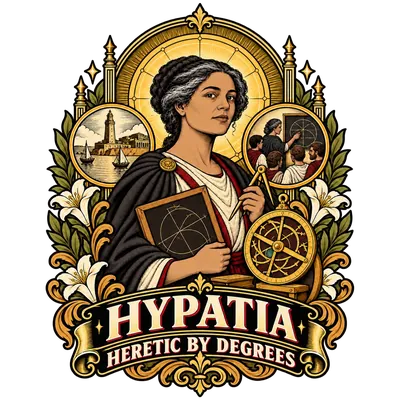
Remember her for this
Hypatia’s father, the mathematician Theon, wrote a commentary on Ptolemy’s Almagest, and a heading in it says that one book was revised or checked by “the philosopher, my daughter Hypatia”. Scholars still argue over how much she did. None of her own books survives intact. The heading does.
Her story
Hypatia taught philosophy and mathematics in public in Alexandria and advised its imperial governor, until a rumour said she was keeping him from making peace with the bishop, and a Christian mob killed her.
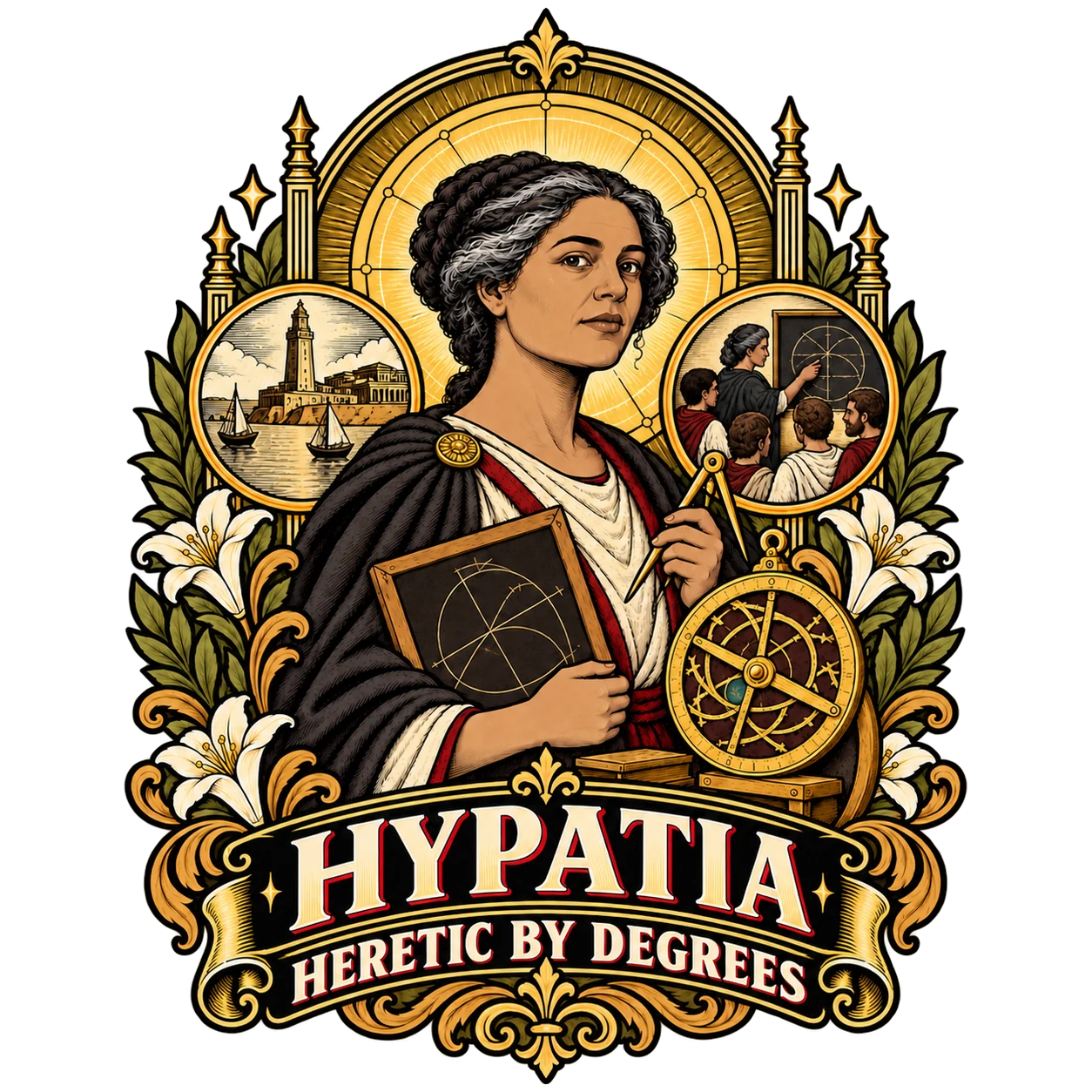
In early fifth-century Alexandria, people who wanted to study philosophy went to a woman. Hypatia taught in public, wore the philosopher’s cloak and, in time, had the ear of the city’s imperial governor.
She was the daughter of Theon, a mathematician and astronomer known for his editions of and commentaries on Greek mathematical texts. Like him, she worked in mathematics and astronomy as well as philosophy. Her birth date is uncertain. Recent studies put it around 355; an older view puts it around 370.
A heading in Theon’s commentary on Ptolemy’s Almagest says that one book was revised or checked by “the philosopher, my daughter Hypatia”. A single late source, the Suda, a tenth-century Byzantine encyclopedia drawing on earlier writers, credits her with commentaries on Diophantus’s Arithmetica and Apollonius’s Conics, and with an “Astronomical Canon”. No book by Hypatia survives intact, and scholars still argue about exactly what she contributed. She was one of the people who corrected, taught and passed on difficult mathematical texts, and her work is hard to separate from the texts themselves.
Her pupils included members of the elite, Christians and pagans alike. One of them, Synesius of Cyrene, wrote to her for years, and his own work on an astrolabe drew on teaching associated with her school. In 402 he asked her to have a hydroscope made for him. A few years later he sent her his two new books, the Dion and On Dreams, and said he would await her decision on them. In 409 or 410 he was elected a Christian bishop, and he went on writing to her. In a letter from his sickbed around 413, he addressed her as mother, sister, teacher and benefactor. His letters show a working network of pupils around her.
By 415 Alexandria was caught in a struggle between Orestes, the imperial governor, and Cyril, the city’s bishop. It involved civic authority and church power, violence between Christian and Jewish communities, and attacks on Orestes by monks. Hypatia advised Orestes and was publicly associated with him. A rumour spread that she was the one preventing a reconciliation.
In March 415 a Christian mob, led by a church official called Peter, seized her carriage. They dragged her to the Caesareum, killed her and burned her remains. If she was born around 355, she was about sixty. Socrates Scholasticus, a historian writing not long afterwards, blamed political envy and religious passion, and said the murder brought no small disgrace on Cyril and on the Alexandrian church. He did not say that Cyril ordered it. Damascius, a pagan writing about a century later, blamed Cyril directly.
Then the retellings began. Christian authors made her a warning or an embarrassment. Enlightenment writers made her a martyr to reason. Later writers made her young, and modern books and films have made her an atheist scientist fighting the destruction of the library.
In the ancient sources she is something else: a Platonist philosopher in a religious world, who taught Christians and pagans in public, revised or checked her father’s work on Ptolemy, and was consulted by a governor, in a city where rival authorities had learned to use crowds. Philosophy and mathematics went on being taught in Alexandria after her. Her father’s commentary calls her “the philosopher”.
The trouble with Hypatia
Hypatia would not keep her learning private. She taught philosophy and mathematics to Christians and pagans in public, wore the philosopher’s cloak and advised the imperial governor, holding authority outside the church just as a bishop was expanding his. When governor and bishop fell out, a rumour made her the obstacle between them, and a mob made the rumour useful.
What the usual story gets wrong
-
“Hypatia was murdered defending the Library of Alexandria.”
Verdict: False
No ancient source connects her death with the Great Library. The famous Ptolemaic library had declined or disappeared long before 415, and the Serapeum was destroyed in 391 or 392, about a quarter of a century before her murder. The mob that killed her took her to the Caesareum.
-
“She invented the astrolabe and the hydrometer.”
Verdict: False
The astrolabe was centuries older than she was, and her father Theon had written on it. The earliest known description of a hydrometer is in a letter her pupil Synesius sent her in 402, asking her to have one made for him. No ancient source says she invented either. His letters show instruments being discussed and made among her circle, and his own work on an astrolabe drew on teaching associated with her school.
-
“Cyril ordered her murder.”
Verdict: Disputed
Socrates Scholasticus, the roughly contemporary historian, says a Christian mob led by a church official called Peter killed her, and that the crime brought no small disgrace on Cyril and on the Alexandrian church, but he does not accuse Cyril of giving the order. Damascius, writing about a century later, blames Cyril more directly, and his account is coloured by hostility to him. The evidence does not settle it.
-
“Hypatia was the last pagan philosopher.”
Verdict: False
Pagan philosophy and mathematical teaching went on in Alexandria after 415. Her death marks an escalation of political violence in the city, not the end of ancient learning.
-
“She was young and beautiful when she died.”
Verdict: Little evidence
Damascius, writing about a century after her death, says she was very beautiful, so beautiful that one of the men at her lectures fell in love with her. No ancient source says she was young when she died. The sixth-century chronicler Malalas calls her an old woman. Recent studies put her birth around 355, which would make her about sixty; even the later date some scholars give, around 370, makes her about forty-five. No portrait of her from life survives.
Sources & rabbit holes
None of Hypatia’s own writing survives intact, so the evidence comes from other people, and the near-contemporary sources are short and politically interested. Synesius’s letters are the best evidence for her teaching and her pupils. Socrates Scholasticus gives the strongest account of her murder. Damascius wrote about a century later, and his details are coloured by hostility to Cyril. Most confident claims about her appearance, her inventions, her exact writings or the Library go beyond what they say. Edward Watts’s 2017 biography is the strongest modern guide to her life and to the legend that grew from it.
Primary sources
-
Church History, Book VII, chapter 15: Of Hypatia the Female Philosopher (opens in a new tab)
Free to read. The fullest early account of her standing and her murder, by a church historian writing about twenty-five years later, who admired her learning and blamed her death on political jealousy.
-
Letter 15: To the Philosopher (Hypatia) (opens in a new tab)
Free to read. Her former pupil writes that he is in such bad luck that he needs a hydroscope, asks her to have one cast in brass, and describes how it works.
Academic papers
-
Hypatia (opens in a new tab)
Free to read. A scholar’s short synthesis of what the ancient sources say, the politics of Alexandria that killed her, and what later centuries made of her.
-
Hypatia and Her Mathematics (opens in a new tab)
A mathematician weighs which surviving works can really be credited to her, and how far. Subscription access.
Books
-
The Cambridge History of Science, Volume 1: Ancient Science (opens in a new tab)
The wider world of ancient science, with a chapter by Miira Tuominen on science in the philosophical schools of late antiquity, the world in which Hypatia taught. Subscription access online.
-
Hypatia: The Life and Legend of an Ancient Philosopher (opens in a new tab)
The fullest modern life, following her teaching and public career and then tracing how her legend grew after her death.
-
Hypatia of Alexandria (opens in a new tab)
The foundational modern study, which separates the woman in the ancient evidence, much of it the letters of her pupil Synesius, from the legend.
-
Women in the History of Science: A Sourcebook (opens in a new tab)
Free to read. Its chapter on Hypatia, by Aiste Celkyte, sets a letter by her pupil Synesius beside an account of her teaching, and explains why the claim that she invented the astrolabe is now widely rejected.