Remember her for this
In 1844 the King of Saxony’s physician walked into a fossil shop in Lyme Regis and wanted the owner’s address. She wrote her name in his pocket-book with a firm hand and, handing it back, told him: “I am well known throughout the whole of Europe.”
Her story
Mary Anning, a carpenter’s daughter from Lyme Regis, dug the first great skeletons of Jurassic sea dragons out of the Dorset cliffs and helped convince the world that animals could vanish for ever, while the scientific society that studied her finds kept her out.
The cliffs at Lyme Regis are always falling down. Storms bring down slabs of grey rock with things inside them that have been dead for about two hundred million years, and Mary Anning spent her life getting there first.
She was born in Lyme in 1799, into a poor family of Dissenters, Protestants outside the Church of England. Her father, a carpenter who sold fossils to visitors, died in 1810, leaving £120 of debts. Mary was eleven. By her own account, a lady on the shore then gave her half a crown for a fossil she had found, and the family had a trade. She had little schooling, and spelled as words sounded. The rest she taught herself.
In 1811 her brother, Joseph, found a skull in the cliff. The next year Mary, now thirteen, found the body and spent months digging it out. It was five metres long. In 1814 it became the first ichthyosaur described in a scientific paper, which named the landowner who had bought it, not the Annings.
Named Ichthyosaurus, ‘fish lizard’, it took its place in the unsettling new idea that whole kinds of animals had lived and vanished long before anyone was there to see them.
On 10 December 1823 she made the find of her life, the first almost complete plesiosaur, with a small head on a neck as long as the rest of its body. In Paris, Georges Cuvier, the most influential naturalist of the age, saw a drawing and suspected a fake.
Mary was in no doubt. She sent her own sketch to a gentleman collector, Sir Henry Bunbury, and told him: “one thing I may venture to assure you it is the first and only one discovered in Europe.” She priced it at £110.
In February 1824 her plesiosaur went to a meeting of the Geological Society. She could not, because the Society did not admit women. The paper that came out of the meeting named the duke who had bought it, not her.
Cuvier came round, and sent a geologist to buy one for Paris. Mary sold him a plesiosaur she had bought from another collector for £3. She charged £10.
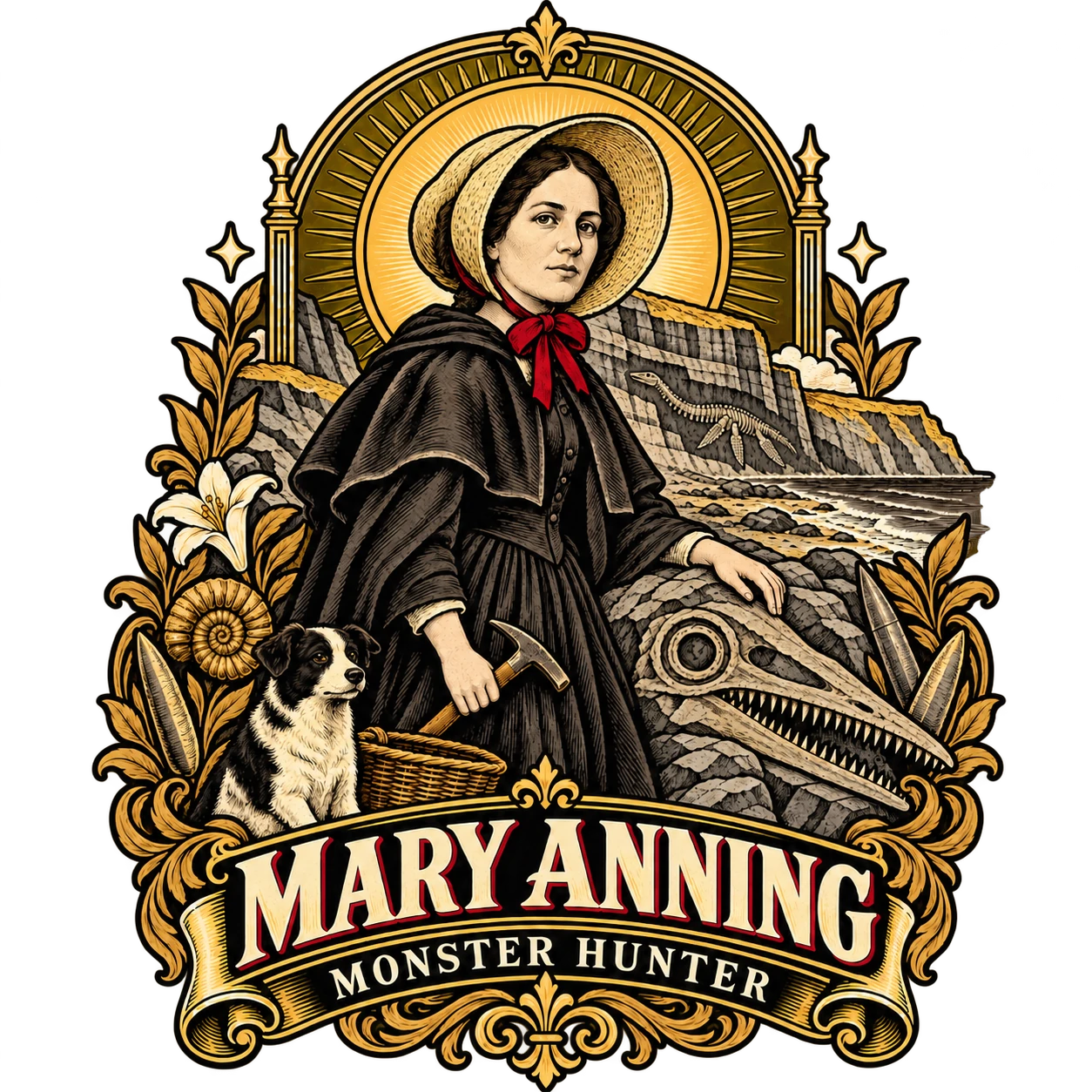
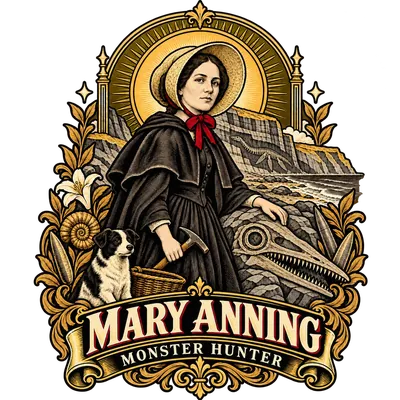
In 1825 the geologist Roderick Murchison found her in a trench on the beach after a storm, “with her dog, hammer & basket”, and wrote in his diary that “her genius in grouping the dislocated bones of any one of the Sauri is astonishing”.
In December 1828 she dug out a winged reptile, the first pterosaur found outside Germany. William Buckland, presenting it to the Geological Society, called it a monster resembling nothing on earth “excepting the dragons of romance and heraldry”.
By 1824 she had worked out that the stony lumps found inside her ichthyosaurs were fossil dung. Buckland published the idea in 1829.
All of it came out of crumbling cliffs, against weather and tide. In 1829 she was nearly drowned freeing part of a plesiosaur. In 1833 a rockfall killed her dog: “the Cliff fell upon him and killed him in a moment before my eyes, and clost to my feet, it was but a moment between me and the same fate.”
She could tell the gentlemen when they were wrong. In 1833 she warned Thomas Hawkins, a Fellow of the Geological Society, that an ichthyosaur he wanted, set in rock riddled with pyrite, would fall to pieces as soon as it dried. Then, by his own account, she added: “that I can prevent. Can you.”
In 1844 the physician to the King of Saxony came into her shop and wanted her address. She wrote her name in his pocket-book with a firm hand and, handing it back, told him: “I am well known throughout the whole of Europe.”
Fame did not pay. She died of breast cancer on 9 March 1847, aged 47. The next February her friend Henry De la Beche, now President of the Geological Society, broke with custom. The annual address mourned the Society’s own dead Fellows; he added a tribute to a woman who could never have been one, who “had to earn her daily bread by her labour, yet contributed by her talents and untiring researches in no small degree to our knowledge”.
The Society elected its first women Fellows on 21 May 1919. It would have been her 120th birthday.
The trouble with Mary Anning
Mary Anning was poor, a woman, a Dissenter and self-taught, in a science run by gentlemen and clergymen, and she would not shrink to fit it. She priced her fossils like the rarities they were and asked a Fellow of the Geological Society to his face whether he could save a crumbling skeleton the way she could. The men who bought her finds published them, mostly without her name, and the Society kept her out.
What the usual story gets wrong
-
“Mary Anning was a dinosaur hunter.”
Verdict: False
None of her great finds was a dinosaur. Ichthyosaurs and plesiosaurs were sea reptiles, and her Dimorphodon was a pterosaur, a flying reptile from a separate group. Her first ichthyosaur came out of the cliff in 1812, twelve years before the first dinosaur, Megalosaurus, was described, and thirty years before Richard Owen coined the word ‘dinosaur’ in 1842. The Natural History Museum rates her plesiosaur as arguably more important than the dinosaurs in convincing people that the Earth was ancient and that animals could die out. The same cliffs did yield a near-complete dinosaur, Scelidosaurus, in the late 1850s, a decade after her death; James Harrison found it.
-
“At twelve, she discovered the first ichthyosaur.”
Verdict: Oversimplified
Her brother Joseph found the skull, in 1811. Mary found the rest of the skeleton the next year, aged thirteen, and dug it out. Fragments of ichthyosaurs had turned up before and been taken for crocodiles; the Annings’ specimen became famous as the first to be described scientifically, by Everard Home in 1814.
-
“Male scientists stole her discoveries, and nobody knew who she was.”
Verdict: Oversimplified
The first half has real substance. Many papers on her finds named only the gentlemen who bought them, and she was never allowed to join the Geological Society. The second half is wrong. In her lifetime she was famous in her field. Geologists sought her out, relied on her advice, raised the money for her annuity and named a fossil fish after her, and the Geological Society, whose archive holds her letters, describes her as well regarded among the geologists who knew her. Her name faded from her fossils only after her death.
-
“The tongue-twister ‘She sells seashells on the seashore’ was written about her.”
Verdict: Little evidence
Nobody has produced any evidence for it. ‘She sells sea shells’ was in print as an elocution exercise by 1855, and ‘at the sea shore’ had joined it by 1898. Terry Sullivan’s 1908 music-hall song, usually named as the tribute, is about a singer stuck with an unpronounceable chorus and never mentions her. Nor did she sell seashells by the shore. She sold fossils, from a table outside the family house and later from a shop in the town.
-
“She and Charlotte Murchison were lovers, as in the film Ammonite.”
Verdict: Little evidence
Charlotte Murchison was real, and a real friend. In 1825 she spent two weeks fossil hunting with Mary while her husband toured the coast, and for years afterwards the two women wrote to each other, Charlotte passing on orders from collectors in London. She was also eleven years older than Mary, and married. No evidence of a romance between them has been found, and none survives of any romance in Mary’s life.
Sources & rabbit holes
The core evidence is her own, and there is little of it. About fifty of her letters survive, because her papers were sold off and scattered after her death. The richest are her December 1823 letters offering the plesiosaur for sale, now at Wellcome Collection, and her letters to Charlotte Murchison at the Geological Society. Around them sit the diaries, papers and travel accounts of the people who bought from her, and a short life by the Lyme schoolmaster George Roberts, written while she was alive and published in full only in 2023. The much-quoted 1865 article in All the Year Round, long credited to Charles Dickens, was written by Henry Stuart Fagan, and errors from it are still repeated. The modern picture of her rests on decades of archive work by Hugh Torrens, Tom Sharpe and Michael Taylor.
Primary sources
-
Autograph letter concerning the discovery of plesiosaurus, from Mary Anning; sketch of plesiosaurus (opens in a new tab)
Her own pen-and-ink drawing of the plesiosaur, sent with her letter offering it to Sir Henry Bunbury as “the first and only one discovered in Europe”.
-
The King of Saxony’s Journey through England and Scotland in the Year 1844 (opens in a new tab)
Page 197: the King’s physician walks into her shop, admires a six-foot ichthyosaur, and is told that she is “well known throughout the whole of Europe”.
Museums & archives
-
Mary Anning and the Geological Society (opens in a new tab)
Her letters to Charlotte Murchison, Murchison’s diary of finding her on the beach after a storm, De la Beche’s 1848 tribute, and the papers that used her finds, with and without her name.
-
Mary Anning fossils: seven highlights from the Jurassic Coast (opens in a new tab)
Her ichthyosaur, plesiosaur and pterosaur, and where to find them in the museum’s galleries today.
-
The Mary Anning experts (opens in a new tab)
The museum stands on the site of her family home and first shop. Its page maps the places in Lyme connected with her, from the chapel where she learned to read to her grave.
Academic papers
-
Mary Anning (1799–1847) of Lyme; ‘the greatest fossilist the world ever knew’ (opens in a new tab)
The presidential address to the British Society for the History of Science that began rebuilding her life from the archives.
-
The Life of Mary Anning, Fossil Collector of Lyme Regis: a Contemporary Biographical Memoir by George Roberts (opens in a new tab)
A short life written by a Lyme schoolmaster who met her many times, found in the University of Bristol’s archives and published in full.
-
Mary Anning’s legacy to French vertebrate palaeontology (opens in a new tab)
The ichthyosaurs and plesiosaur Cuvier bought from her for Paris, re-examined for the first time since he described them.
Books
-
The Fossil Woman: A Life of Mary Anning (opens in a new tab)
The fullest modern biography, illustrated and built on recent archive research, and the life of her the Geological Society recommends.
Watch
-
Who was Mary Anning and what did she discover? (opens in a new tab)
A six-minute film on her life and her major finds, from the museum that holds many of them.
Listen
-
You’re Dead to Me: Mary Anning (opens in a new tab)
A comedian and an Anning scholar on her life, her finds and the scientific establishment that shut her out.
Further reading
-
Would you like to buy a dinosaur? (opens in a new tab)
Her two 1823 plesiosaur letters read closely, and what they show of her as a dealer who knew her market.
-
She Sells Seashells and Mary Anning: Metafolklore with a Twist (opens in a new tab)
A folklorist traces the tongue-twister back to 1855 and finds no trace of her in it.
-
‘Ammonite’ Is Historical Fan Fiction About the World’s First Great Fossil Hunter (opens in a new tab)
A palaeontology writer on what the 2020 film invents, and what the record shows about Mary and Charlotte Murchison.