Portrait made with AI image tools from our own research and art direction.
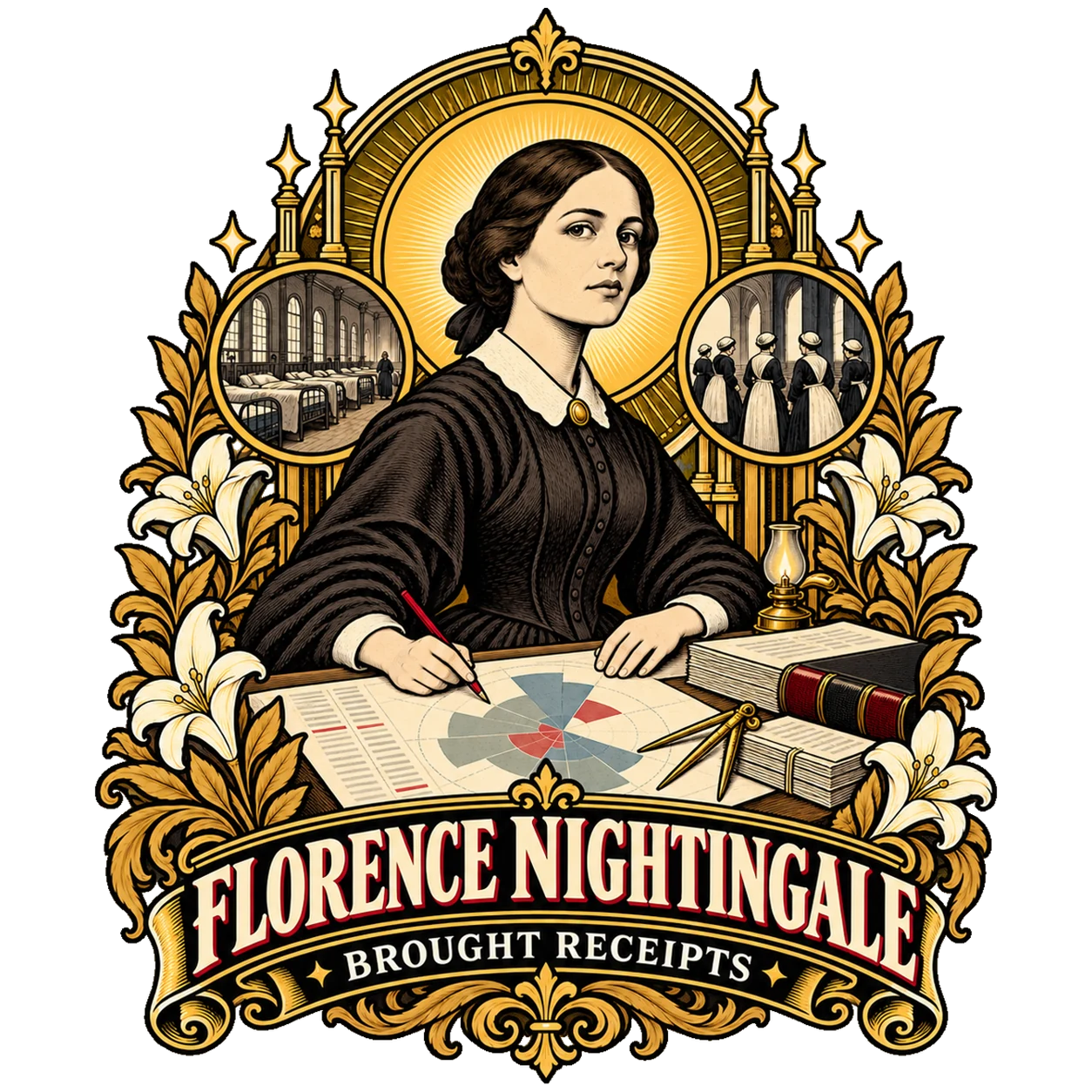
In the portrait: The coloured wedges under her hand are a polar-area diagram, the chart she used to make the evidence visible to ministers who might ignore a table. The roundels show the wards at Scutari and the trained nurses of her school at St Thomas’ Hospital. The lamp is there too, small, at the edge of the desk.
№ 015 · 1820–1910
Florence Nightingale
In the Archive · Shirt coming soon
Florence Nightingale went to the Crimean War with thirty-eight nurses, came home with eighteen thousand deaths arranged in tables, and made the government look at them.
Remember her for this
Florence Nightingale’s most important report on the Crimean War ran to 853 pages and was never published. She had it printed privately in 1858 for ministers, officials and a few influential friends. Her famous diagrams take up only a few of those pages. They were there so that ministers who might not read the rest could not miss the point.
Her story
Florence Nightingale is remembered walking through a dark ward with a lamp. It is a beautiful image, and much easier to picture than an 853-page statistical report.
She was born in Florence in 1820, into a wealthy British family, and educated at home, unusually thoroughly, in languages, philosophy and mathematics. Nursing was not a respectable career for a woman of her class, and her family expected her to marry. Nightingale believed God had called her to useful work, and spent years wearing them down.
In 1851 she trained at Kaiserswerth in Germany, and two years later she became superintendent of a hospital for gentlewomen in London. Then reports from the Crimean War described wounded British soldiers lying in filthy, badly supplied hospitals. Sidney Herbert, the Secretary at War, asked her to take nurses to the military hospital at Scutari, near Constantinople.
She arrived in November 1854 with thirty-eight nurses. The hospital was overcrowded, infested and short of food, bedding and basic supplies. She organised its kitchens, laundries, stores and nursing, and fought military administrators who disliked civilians, women and anybody keeping count.
The death rate eventually fell. The whole site was in a catastrophic sanitary state. The government’s Sanitary Commission did much of the engineering that made the decisive change, removing filth and improving the drains and ventilation. Nightingale’s own understanding of disease was still developing. What she did was organise care inside a failed system, collect the evidence of its failure, and refuse to let anyone forget it.
She came home quietly in 1856, and spent much of the rest of her life working from her rooms and her bed, often in severe ill health. With the statistician William Farr and other experts, she compared deaths from wounds with deaths from preventable disease. Disease had killed far more soldiers than battle. Her full report, printed privately under her own name in 1858, went to ministers and officials. The shorter pamphlets that took the figures to a wider readership went out without her name.
She set the figures out as polar-area charts, a form she used with considerable skill and labelled carefully, so that ministers who might not read the tables could still see the numbers.
In 1858 she became the first woman elected a fellow of the Statistical Society of London. In 1860 the Nightingale Training School opened at St Thomas’ Hospital, paid for by public donations. Its nurses carried a professional model of nursing into hospitals in Britain and abroad. Her Notes on Nursing explained that good care depended on air, light, cleanliness, quiet, food and observation, not simply on obeying a doctor.
Her later work ranged far beyond nursing, into hospital design, the health of barracks, workhouse infirmaries and sanitation in India. Some of it sat firmly inside the machinery of the British Empire. She could recognise preventable death in colonial statistics while still assuming that British administration had the authority to fix other people’s lives.
She wrote more than two hundred books, reports and pamphlets, and thousands of letters, and when the answers did not come, she wrote again.
The trouble with Florence Nightingale
Florence Nightingale did not hand the government a moving story and go home. She turned the army’s deaths into figures that could be compared, recruited experts, circulated reports, and kept asking, for decades and often from her bed, which official decisions had produced which avoidable deaths.
What the usual story gets wrong
-
“The Lady with the Lamp single-handedly cut the Crimean death rate.”
Verdict: False
She transformed nursing and the running of the hospital, but the Sanitary Commission’s engineering work was central to the dramatic fall in deaths. She worked with nurses, doctors, statisticians, officials and reformers.
-
“She invented the pie chart.”
Verdict: False
Circular statistical graphics existed before her. Hers were polar-area diagrams, a related form, and she used them with exceptional skill, knowing that a picture could make an administrative argument impossible to ignore.
-
“Florence Nightingale and Mary Seacole were rivals.”
Verdict: Little evidence
Mary Seacole, a Jamaican-born healer and businesswoman, had her offer to nurse refused in London after Nightingale had left, and paid her own way to the Crimea. The two women met at Scutari in March 1855, when Nightingale found her a bed for the night. Seacole says she later saw much of her at Balaklava; the Nightingale scholar Lynn McDonald counts only that one brief meeting. Nightingale ran the army’s female nurses from Scutari and visited the Crimean hospitals. Seacole ran the British Hotel, a store and canteen near Balaklava, and treated soldiers there and in the field. Years later, in a private letter, Nightingale wrote that anyone who employed Seacole would “introduce much kindness – also much drunkenness and improper conduct”. The friction was private and largely one-sided, and there is no evidence of a professional rivalry. The public contest between them is modern, and says more about how commemoration makes room for one famous woman at a time than about either woman’s work.
-
“She stopped working after the Crimean War because she was an invalid.”
Verdict: False
Ill health limited her movement, but from her rooms in Britain she drove decades of reform through research, letters, lobbying, publications and a formidable network of collaborators.
Sources & rabbit holes
The core evidence is her own, and there is a great deal of it, from Notes on Matters Affecting the Health, Efficiency, and Hospital Administration of the British Army (1858) and Notes on Nursing (1860) to thousands of letters. Lynn McDonald’s sixteen-volume Collected Works of Florence Nightingale is the scholarly edition. She created a large archive and managed her own public image, and Victorian commemoration made her a saintly nurse. Recent statistical histories restore her collaborators: William Farr shaped the analysis, and the Sanitary Commission’s reforms saved lives in the Crimea. Hugh Small’s Florence Nightingale: Avenging Angel (1998) is a revisionist account of the Crimean evidence, best read alongside McDonald. Her work on India belongs to the history of the British Empire as well as to public health.
Primary sources
-
Notes on Nursing: What It Is, and What It Is Not (opens in a new tab)
Free to read. Her practical book for anyone caring for the sick at home, on fresh air, light, quiet, food and watching the patient.
-
Notes on Matters Affecting the Health, Efficiency, and Hospital Administration of the British Army (opens in a new tab)
Free to read. The report she compiled for the Secretary of State for War after the Crimea, on the army’s sickness and death rates in war and in peacetime, and what caused them.
Museums & archives
-
Nightingale, Florence (1820–1910) (opens in a new tab)
The catalogue of her letters at the Wellcome, covering her whole life: the fight to become a nurse, the Crimea, nursing reform, sanitation in India and medical statistics, with letters to William Farr among many others.
-
Lady in the Archives: The life of Florence Nightingale (part two) (opens in a new tab)
Original documents from Scutari and after: her letters to the War Office, the rules issued to her nurses, letters from women desperate to go to the war, and her 1858 report on the army’s health.
-
Florence Nightingale (opens in a new tab)
The museum’s account of her training, the Crimea, the founding of professional nursing and the campaigns of her later life.
Books
-
The Collected Works of Florence Nightingale (opens in a new tab)
The sixteen-volume scholarly edition of her surviving writing, much of it published for the first time.
-
Florence Nightingale: Avenging Angel (opens in a new tab)
A revisionist reading of the Crimean evidence, first published in Britain in 1998; best read alongside McDonald’s edition rather than on its own. Free to borrow online with an Internet Archive account.
Further reading
-
Florence Nightingale and Statistics: From Then to Now (opens in a new tab)
The summary of a talk by the editor of her collected works, on her 853-page analysis of 1858, the polar-area charts she made with William Farr, and the bar charts she used just as cleverly.
-
Florence Nightingale and her team: Getting the statistics right, getting them to work for good (opens in a new tab)
The summary of a talk on how she always worked with experts, and how the Sanitary Commission’s clearing of “filth” and dead horses cut the Crimean death rate while the army’s medical department published charts of barometric pressure.