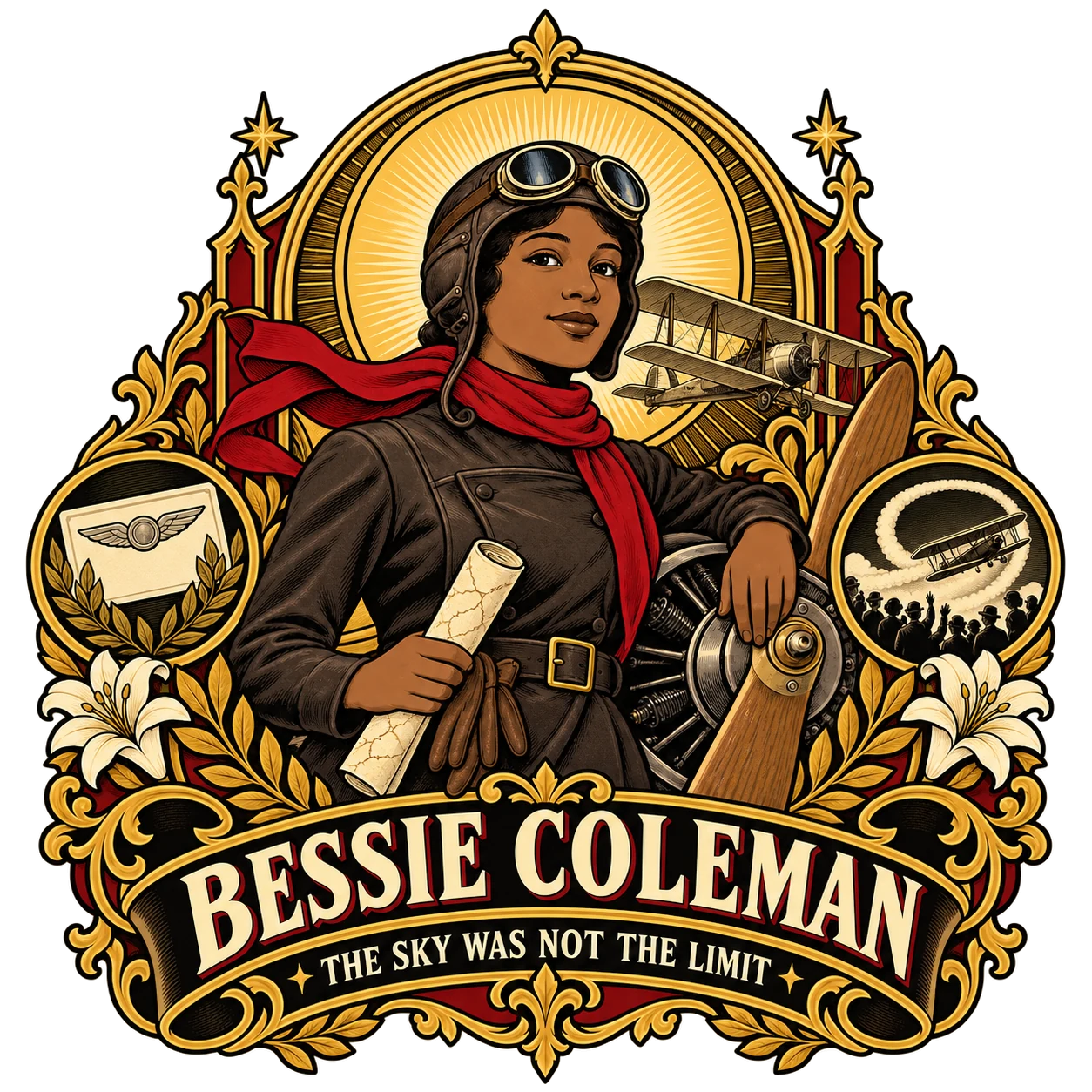
Remember her for this
In Chicago, Bessie Coleman’s brother John teased her that French women flew aeroplanes while she could not. American instructors refused to teach her. So she learned French, and in November 1920 she sailed for Europe. On 15 June 1921 she became the first African American woman to hold an international pilot’s licence.
Her story
Bessie Coleman was turned away by American flight schools, so she learned French, trained in France and came home with an international pilot’s licence, then refused to fly where Black spectators were made to use a separate entrance.
In 1920 Bessie Coleman asked American pilots to teach her to fly. They turned her down on two grounds, neither of them aerodynamic. She was Black, and she was a woman.
Coleman was born in Atlanta, Texas, in 1892, one of thirteen children. Her mother, Susan, was Black. Her father, George, had Black and Native American ancestry. Bessie picked cotton, went to a one-room school and briefly attended what is now Langston University, until the money ran out.
In 1915 she followed her older brothers to Chicago in the Great Migration. She worked as a manicurist on the South Side, where customers and newspapers talked about the pilots coming home from the First World War. Her brother John teased her that French women flew aeroplanes while she could not. Coleman took it as advice.
Robert Abbott, publisher of the Chicago Defender, advised her to train in France and helped publicise the plan. Coleman learned French, saved money and found backing from the banker Jesse Binga. In November 1920 she sailed for Europe.
The Caudron brothers’ school at Le Crotoy took her. She trained on a Nieuport 82, and on 15 June 1921 she received a licence from the Fédération Aéronautique Internationale. She was the first African American woman to hold an international pilot’s licence, and the Smithsonian counts her the first Native American woman too.
A licence did not bring an American flying job. Commercial aviation barely existed, and no one would hire a Black woman as an instructor. Air shows paid. Coleman went back to Europe for advanced training with stunt pilots, then made her first public flight in America in September 1922, in a borrowed Curtiss Jenny.
Barnstorming was dangerous theatre: loops, figure-eights and parachute jumps, in unreliable surplus aircraft, close enough for a crowd to feel the engine. Coleman wore a custom-made, military-style flying suit and went by the press names “Queen Bess” and “Brave Bessie”. She gave lectures and showed films of her training in Europe. The talks often paid better than the aeroplane.
She set conditions. She refused to perform where Black spectators were shut out or sent through a separate entrance. She walked away from a film role she considered demeaning. Her long plan was a flight school open to Black students, paid for by shows, lectures and a beauty business.
In February 1923 her Jenny’s engine failed after take-off in California. She broke a leg and three ribs. Within two years she was flying again, drawing large Black audiences through Texas and the South. In 1925, in Waxahachie, the Texas town where she grew up, she would not fly until Black and white spectators came in through the same gate. Inside, they still sat apart. Black communities, women especially, gave her rooms, meals and safety on the road. A Black woman forced down in a segregated town could not count on help or safety.
On 30 April 1926 Coleman went up over Jacksonville, Florida, to scout a landing site for a parachute jump at the next day’s show. Her mechanic and publicity agent, William Wills, was flying. Coleman had left her seat belt off so that she could lean over the cockpit. The aircraft went into an uncontrolled dive and flipped, and she fell to her death. Wills died when the plane struck the ground and burned. Investigators found that a loose wrench had jammed the controls.
She was thirty-four, and her flying career had lasted barely five years. Her school never opened. In Los Angeles the Bessie Coleman Aero Club trained and promoted Black aviators, and Black pilots began flying over her grave every year.
The trouble with Bessie Coleman
Bessie Coleman would not let American flight schools decide whether she could fly. Turned away for being Black and a woman, she learned French, trained in France and came home with an international licence. Then she set her own conditions: no shows where Black spectators were sent through a separate entrance, and no film role she found demeaning.
What the usual story gets wrong
-
“Bessie Coleman was the first Black pilot.”
Verdict: False
Eugene Bullard, an African American, qualified as a military pilot in France in 1917 and flew combat missions in the First World War, years before Coleman trained. Her first is narrower, and hers: on 15 June 1921 she became the first African American woman to hold an international pilot’s licence, issued by the Fédération Aéronautique Internationale.
-
“She was the first American woman pilot.”
Verdict: False
Harriet Quimby received an American pilot’s certificate in 1911. Coleman’s first was the one that crossed both race and gender: she was the first licensed Black woman pilot.
-
“Bessie Coleman was Cherokee.”
Verdict: Disputed
Her father, George, had Black and Native American ancestry, and the Smithsonian describes Coleman as the first Native American woman licensed to fly. Claims that she was Cherokee, or Choctaw, are repeated more confidently than the documents support, and a specific tribal identity is difficult to establish.
-
“She said, “The air is the only place free from prejudice.””
Verdict: Little evidence
The line fits her story and circulates widely, but nobody has traced it to a reliable primary source. Her own conditions are better documented: she refused to perform where Black spectators were sent through a separate entrance.
Sources & rabbit holes
The core evidence is the contemporary Black press, which reported her licence, her lectures, her exhibitions and her death, and shows how she presented herself and how her audiences understood what she had done. The Library of Congress gathers it in Chronicling America. The National Air and Space Museum gives the best institutional account, and is open about where evidence ends and rumour begins around the fatal crash. Doris Rich’s 1993 Queen Bess is the standard full biography. Her specific tribal ancestry, and some of the polished quotations attributed to her, remain uncertain.
Primary sources
-
Search Strategies & Selected Articles (opens in a new tab)
Free to read. Links to digitised newspaper pages reporting her licence, her lectures and flying exhibitions, and her death in 1926.
Museums & archives
-
Bessie Coleman (opens in a new tab)
An illustrated story of her life for the licence’s centenary, from the prize-winning Chicago manicurist to the barnstormer, with a podcast episode about her.
-
Bessie Coleman: Topics in Chronicling America (opens in a new tab)
A guide to what the newspapers of her day wrote about her, with a timeline. The timeline puts her licence in 1922; the FAI issued it on 15 June 1921.
-
100 Years Since FAI Granted Bessie Coleman’s Pilot Licence (opens in a new tab)
The body that issued her licence on 15 June 1921 marks its centenary: why no American school would teach her, and her seven months of training in France.
-
Bessie Coleman (opens in a new tab)
Her hall of fame entry: the licence, the lecture tours to fund a flying school, her refusal to perform for segregated crowds, and the Bessie Coleman Aero Club founded in Los Angeles after her death.
Books
-
Queen Bess: Daredevil Aviator (opens in a new tab)
The standard full biography. Free to borrow online with an Internet Archive account.
-
Up in the Air: The Story of Bessie Coleman (opens in a new tab)
A short, accessible life for younger readers, set in the early history of flying. Free to borrow online with an Internet Archive account.
Further reading
-
Bessie Coleman’s Daring Life as the First Licensed Black Woman Pilot (opens in a new tab)
The museum’s centenary life of her, from her training in France and her licence of 15 June 1921 to her air shows and the crash at Jacksonville in 1926 that killed her.
-
How Bessie Coleman Broke Barriers to Make History (opens in a new tab)
Her licence, her refusal to fly for crowds that were not desegregated, and the flight school for African American students she saved for.