Remember her for this
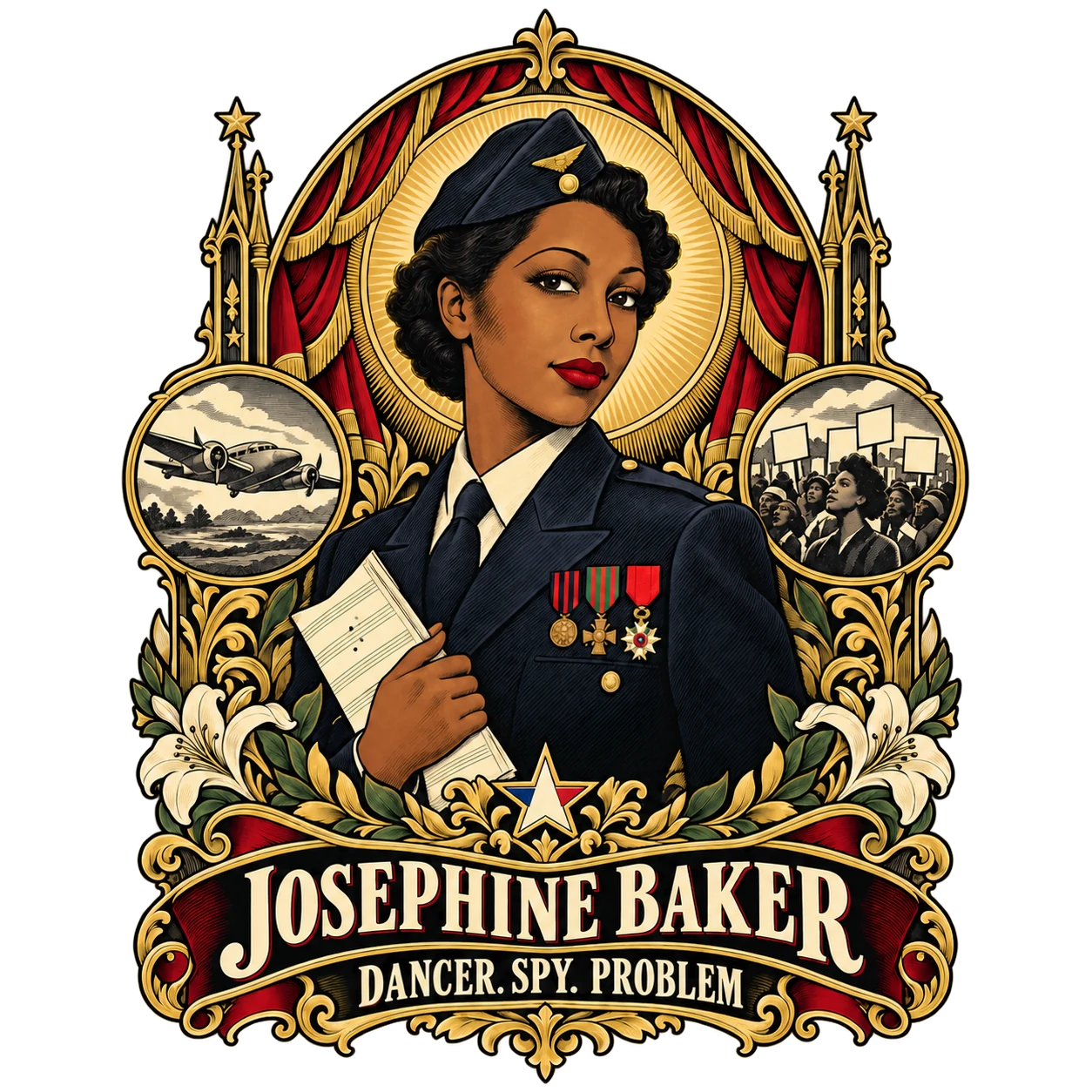
In 1944 Josephine Baker joined the women’s auxiliary of the French Air Force as a sub-lieutenant. She served without taking her pay, and spent months organising and performing concerts near the front. In 1963 she wore the uniform, and the medals France had given her, to the March on Washington.
Her story
Josephine Baker became one of the best-paid entertainers in Europe, carried secret reports for France in invisible ink on her music, then wore her French uniform and medals to the March on Washington.
In 1925 a nineteen-year-old dancer from St Louis walked on to a Paris stage and found that France was ready to make her famous, provided she played the fantasy it had already written for a Black American woman.
She had grown up Freda Josephine McDonald, poor, in domestic service as a child and performing whenever she could. She had seen the East St Louis race violence of 1917. She was married by thirteen, and by sixteen she had taken the name of her second husband, Willie Baker, and joined a touring show. On Broadway she was the comic at the back of the chorus line who pulled focus from everyone in front.
Paris offered a larger stage and another set of prejudices. In La Revue nègre, and later at the Folies Bergère, white audiences applauded a caricature of African wildness, and the famous banana skirt belonged to that act. Baker knew exactly what was being sold.
She also controlled more of the bargain than her audiences expected. She became one of the best-paid entertainers in Europe, learned to sing, starred in films and ran a nightclub.
In 1937 she took French citizenship. When war came, fame turned out to be excellent cover. At parties and embassies she listened while officials talked, then passed what she heard to French counter-intelligence. In 1940 she refused to perform for the German occupiers.
Travelling with the intelligence officer Jacques Abtey, she carried reports written in invisible ink on her music. In North Africa she performed for troops, raised money and worked for Free France. In 1944 she joined the women’s auxiliary of the French Air Force as a sub-lieutenant, and served without taking her pay.
The decorations came later: the Resistance Medal with rosette, the Croix de Guerre and the Légion d’honneur. Most of the vivid detail of her secret work, the invisible ink included, comes from Abtey’s own book of 1948. The surviving military files confirm the service.
After the war Baker took on American segregation. She would not perform for segregated audiences. When the Copa City Club in Miami Beach wanted her, she held out until it agreed in writing to admit its patrons “regardless of race, color and creed”, and in January 1951 she opened there.
That year she was apparently refused service at New York’s Stork Club, and she made the incident national news. Walter Winchell, America’s most popular columnist, had been at the club that night. Months earlier he had praised her Miami Beach show in print and on air. She accused him of watching and doing nothing, which was probably untrue. He hit back by hinting that she was a communist, and the feud badly damaged her reputation and her bookings in America.
On 28 August 1963 she stood at the March on Washington in her French uniform and medals. She told the crowd that she had entered royal palaces and presidents’ homes, but could not get a cup of coffee in an American hotel.
In 1947 she had married her fourth husband, the French bandleader Jo Bouillon. From 1954 they adopted children of different origins and faiths at the Château des Milandes, presented to the world as a “Rainbow Tribe” proving that people could live together. The couple separated in 1957 and divorced in 1961. The adoptions went on: by the mid-1960s there were twelve.
It was a sincere ideal, and also a public exhibit built around children who had not chosen the role. The estate swallowed money, and in 1969, despite public efforts to rescue it, she lost it.
She kept performing. In the spring of 1975 Joséphine à Bobino, a retrospective of her fifty years on the Paris stage, played to ecstatic reviews. On 10 April, two days after its gala première, she suffered a cerebral haemorrhage. She died on 12 April, aged sixty-eight.
In 2021 France honoured her in the Panthéon. Her body stayed in Monaco. The monument holds earth from the places that made her: St Louis, Paris, Milandes and Monaco.
The trouble with Josephine Baker
Josephine Baker was expected to be decorative, and grateful for any stage she was given. She set terms instead. She turned the access that came with fame into intelligence for France, and refused to perform for the German occupiers or for segregated audiences in America. When New York’s Stork Club apparently refused to serve her, she made it national news.
What the usual story gets wrong
-
“She was a dancer in a banana skirt, and not much more.”
Verdict: False
The skirt was one costume, in an act made for white Paris as a fantasy of African wildness. Her career took in singing, films and running a nightclub, then wartime work for French intelligence and Free France, and a long fight against segregation in America.
-
“She smuggled military secrets in her underwear.”
Verdict: Little evidence
Her secret work is real, and the military files confirm it. Its two best-known details, the invisible ink on her sheet music and the notes and photographs pinned inside her clothes, both come from the memoirs of Jacques Abtey, the officer she travelled with, and French official and museum accounts repeat both. Neither detail is recorded in the surviving files.
-
“She was the only woman to speak at the March on Washington.”
Verdict: False
She spoke before the official programme began, in her French uniform, and for longer than any of the women on it. The programme gave women one slot, a tribute that Myrlie Evers was to deliver. Daisy Bates gave it in her place, and Rosa Parks spoke briefly. Gloria Richardson said “Hello” before a marshal took her microphone away. Women organisers had fought for even that one slot.
-
“Josephine Baker is buried in the Panthéon.”
Verdict: False
France inducted her in 2021, but her body remains in Monaco. The coffin in the Panthéon is ceremonial, and holds earth from the places in her life.
Sources & rabbit holes
The firmest evidence for her war is in the French military files at the Service historique de la Défense. They confirm her counter-intelligence contacts from 1939, her air-force service in 1944–45, her rank and her decorations. Most of the vivid detail comes from Jacques Abtey’s 1948 memoir, the earliest published account. The intelligence historian Matthew Hefler calls it “self-serving and polemical”, and finds only part of it borne out by Abtey’s own cables. The Library of Congress holds the NAACP Legal Defense and Educational Fund’s files on the 1951 Stork Club dispute, many of them digitised. Her performances were made inside a racist entertainment business, and the record shows the stereotypes audiences paid for as well as her skill and control. Phyllis Rose’s Jazz Cleopatra (1989) is a critical biography of the performer and the fantasies built around her. For the “Rainbow Tribe” there is Baker’s publicity, and the adopted children’s later testimony. The National Museum of African American History and Culture dates the March on Washington to 1968; it was 1963.
Primary sources
-
Joséphine Baker (opens in a new tab)
In French. Extracts from her air-force career file and Resistance dossiers in the military archives at Vincennes, with a dated account of her intelligence work from 1939 to her demobilisation in 1945 and the honours that followed.
Museums & archives
-
Joséphine Baker (opens in a new tab)
In French. The armed forces ministry’s account of the star who gathered intelligence at Paris receptions in 1939–40, carried notes in invisible ink on her sheet music to Portugal, and served as a sub-lieutenant in the air force’s women’s auxiliary.
-
Joséphine Baker, 5e femme au Panthéon (opens in a new tab)
In French. The national monuments body on her life on stage, in the Resistance and in the fight against racism, and why in 2021 she became the fifth woman honoured in the Panthéon.
-
Joséphine Baker (opens in a new tab)
A short life with Carl Van Vechten’s 1949 portrait of her, linking her career in Paris to her Resistance work and her civil-rights campaigning in the United States.
-
Josephine Baker (opens in a new tab)
A short life with objects from the museum’s collection, including a 1951 poster for her show at the Strand Theater. The page dates the March on Washington, where she spoke, to 1968; it took place in 1963.
Books
-
Jazz Cleopatra: Josephine Baker in Her Time (opens in a new tab)
A critical biography of the performer and of the fantasies Paris built around her. Free to borrow online with an Internet Archive account.
-
Josephine Baker in Art and Life: The Icon and the Image (opens in a new tab)
A sociologist on how she made and remade her own image, on stage and off, through to the ‘Rainbow Tribe’ of children she adopted.
Further reading
-
Six histoires étonnantes de panthéonisés (opens in a new tab)
In French. Six surprising facts about France’s temple to its great dead; the last explains that she is honoured in the Panthéon but still buried in Monaco.
-
Josephine Baker at the Stork Club: A Night Gone Wrong (opens in a new tab)
How being refused service at New York’s most exclusive club in 1951 became a public protest, and then went badly wrong for her, told from the NAACP Legal Defense Fund’s files, now digitised and free to read.