
Remember her for this
In 1843, a century before the first electronic computers, Ada imagined a machine composing music. That machine was never finished, so she never heard a note of it. She wrote the idea down anyway, and left the rest of the world to catch up.
Her story
Ada Lovelace saw that a mechanical calculator could do much more than maths; it could work with music, words and other kinds of information.
Ada Lovelace had a gift for looking at something unfinished and working out what it might become. She was born Augusta Ada Byron in 1815, the daughter of the poet Lord Byron and Anne Isabella Milbanke. Her childhood was unusual and complicated, and very heavily schooled. Her mother encouraged mathematics and logic, and Ada developed an appetite for both at a time when women were rarely invited to treat mathematics as serious intellectual work of their own.
Then she met Charles Babbage, who was building machines to automate calculation. His later design, the Analytical Engine, was a mechanical device meant to be programmed with punched cards, to store information and to carry out sequences of operations. It was never completed, but on paper it held ideas that would later become fundamental to computing.
In 1842 the Italian engineer Luigi Menabrea published a description of the Analytical Engine. Ada translated it into English and, at Babbage’s suggestion, added notes. The notes ended up considerably longer than the original article, because Ada kept pushing at the consequences of the machine. One of them set out a detailed procedure for calculating Bernoulli numbers on the Engine, the first algorithm for it ever published.
Her deeper insight came from asking a different question. Ada was less interested in how fast the Engine could calculate than in whether calculation was even the point at all. She realised that the numbers inside such a machine could stand for other kinds of information as well as quantities. If the relationships between them could be expressed through rules, the Engine could manipulate symbols representing language, music or other forms of information. She even pictured it composing music.
She worked this out with no programmable computer to try it on, let alone a screen, a keyboard, a software industry or digital audio. She was reasoning outward from a machine that existed mostly as plans and partial mechanisms, and she arrived at a general principle: a computer could be a machine for manipulating representations of things. Much more than just a giant calculator.
Almost everything we now consider normal sits on top of that idea. Computers handle text, images, sound, video and code because information can be represented as symbols and transformed according to rules.
For all that imagination, she held the surprisingly modern view that the machine had no magic in it. In her famous discussion of the Analytical Engine she argued that it could do only what we knew how to order it to perform. She let her thinking run well past the evidence in front of her, but never past logic, and she treated mathematics and imagination as partners.
She died in 1852, at thirty-six, long before the technology existed to realise the world she was imagining. She never got the satisfying ending in which somebody switches on the machine and proves her right, and had to do the intellectual work without the reassurance of seeing the future arrive.
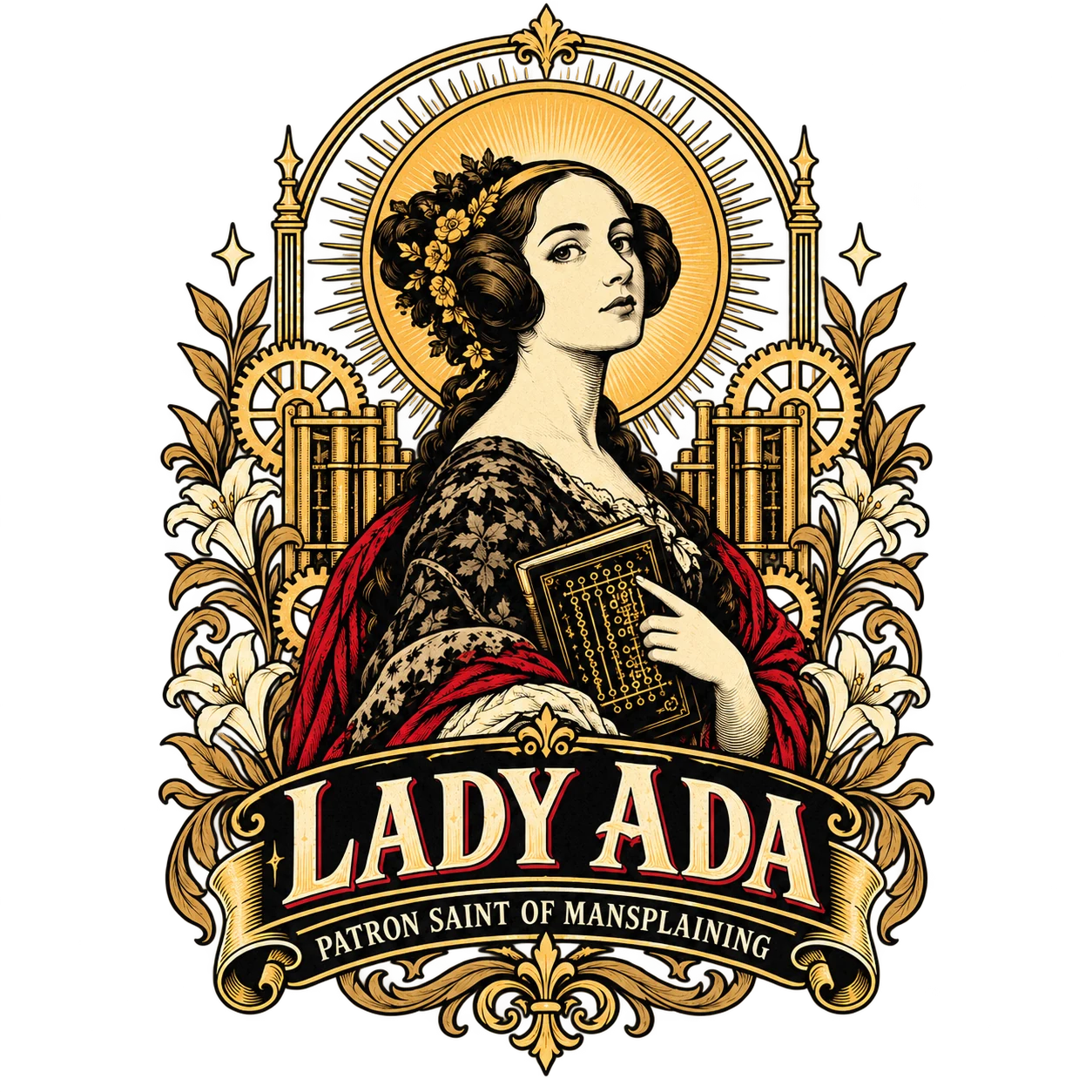
The shirt calls her the Patron Saint of Mansplaining. She and Babbage were collaborators, and both shaped the work, so the joke is aimed at something broader and painfully familiar. Women can be central to a field and still find their competence treated as something requiring verification, qualification or explanation. Ada’s answer is still sitting in her own writing, nearly two centuries later, in Notes that explain the machine and then imagine well beyond it.
The trouble with Ada Lovelace
Victorian intellectual life placed heavy limits on women’s formal participation in science and mathematics. Ada’s rebellion was intellectual. She refused to think only inside the boundaries of the machine in front of her. Babbage concentrated on calculation, while she set out a vision of symbolic, general-purpose computation. She saw past her field’s own assumptions and imagined a future her century had not yet built.
What the usual story gets wrong
-
“Ada Lovelace was the first computer programmer.”
Verdict: Oversimplified
The Science Museum notes that Lovelace’s article contained the first published algorithm for the Analytical Engine, and that Babbage had already sketched similar algorithms in his notebooks. So she has a very strong claim in the history of published programming, but turning it into a story of one person inventing programming hides how collaborative the work was.
-
“She only translated the article. Babbage really wrote the Notes.”
Verdict: False
Babbage’s own memoir says otherwise. They discussed possible illustrations together, he wrote, “but the selection was entirely her own”, and so was the algebra, apart from the Bernoulli calculation, which he offered to do and she sent back for amendment, “having detected a grave mistake which I had made in the process.”
-
“She programmed a working computer.”
Verdict: False
Nothing she wrote ran in her lifetime. The Analytical Engine was a mechanical design that was never completed, so her program was written for a machine that existed only on paper and in partial parts.
-
“Her mother made her study mathematics to stop her turning into a poet like her father.”
Verdict: Little evidence
It is a good story and it is everywhere. Historians who went through the family papers found little evidence for it. The serious education is documented; the motive is not.
Sources & rabbit holes
The core evidence is her own: the 1843 Notes, and her letters to Babbage, De Morgan, Somerville and her mother, held in the Lovelace Byron papers and the Somerville papers at the Bodleian Library. Babbage’s 1864 memoir gives his account of how the Notes were written. From the 1980s onward, influential accounts, Dorothy Stein’s 1985 biography among them, doubted her mathematical ability. This story follows the more recent reassessment by Christopher Hollings, Ursula Martin and Adrian Rice, based on the full correspondence.
Primary sources
-
Sketch of the Analytical Engine, with Notes by the Translator (opens in a new tab)
Her Notes A to G, transcribed from the 1843 printing with the original page scans alongside. Note G holds the Bernoulli table and her warning that the Engine “has no pretensions whatever to originate any thing.”
-
Passages from the Life of a Philosopher (opens in a new tab)
Babbage’s memoir. The chapter on the Analytical Engine gives his account of how the Notes came about, including the mistake she caught.
Museums & archives
-
Ada Lovelace: visionary of the computer age (opens in a new tab)
The museum’s own account, including the point that Babbage had sketched similar algorithms in his notebooks.
-
Babbage’s Analytical Engine, 1834–1871 (trial model) (opens in a new tab)
The only part of the Engine that was ever built: a fragment of its mill, unfinished when Babbage died.
-
Ada Lovelace’s mathematical papers (opens in a new tab)
Her 1840–41 correspondence course with Augustus De Morgan, digitised from the Lovelace Byron papers at the Bodleian Library.
Academic papers
-
The early mathematical education of Ada Lovelace (opens in a new tab)
Open access. Uses the family papers to take apart the claim that she was mathematically weak.
-
Computing Machinery and Intelligence (opens in a new tab)
Section 6, “Lady Lovelace’s Objection”, is Turing’s reply to Note G, 107 years after she wrote it.
Books
-
Ada Lovelace: The Making of a Computer Scientist (opens in a new tab)
Short, illustrated and built from the archive: the steam-powered flying horse, the rainbow letters, the De Morgan course.
Watch
-
The Scientific Life of Ada Lovelace (opens in a new tab)
Public lecture, free to watch, with a transcript.
Listen
-
In Our Time: Ada Lovelace (opens in a new tab)
Three historians in one studio, including Doron Swade, whose doubts about her mathematics the Hollings paper takes on. Worth hearing both sides.
Further reading
-
Comment on: Was Ada Lovelace Actually the First Programmer? (opens in a new tab)
A short note on why “first programmer” is the wrong label for a real achievement.