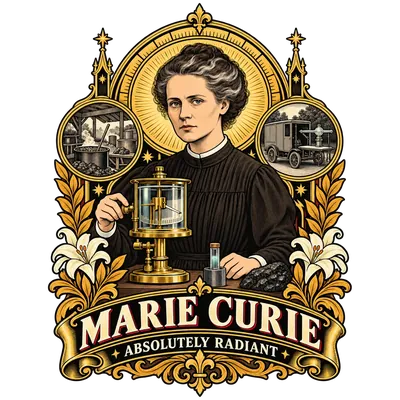
Remember her for this
Marie and Pierre Curie refused to patent their radium process, so that others could use it. Radium grew so expensive that her laboratory had barely a gram. A patent could have funded her institute, friends said, “not without reason”, she admitted. In 1921 American women bought her another, and the world’s most famous scientist crossed the Atlantic to collect it.
Her story
Marie Curie measured a new kind of energy, found two new elements in a black uranium ore, spent years digging radium out of tonnes of its residues, won Nobel Prizes in two different sciences and then drove X-rays to the front.
In 1897 Marie Curie needed a subject for a doctorate. Henri Becquerel had found that uranium salts gave off mysterious rays, and most physicists treated it as an interesting corner. Curie brought an electrometer and started measuring.
She had been born Maria Skłodowska in Warsaw in 1867, when the city was ruled by the Russian Empire and women could not attend the university there. She studied in an underground “Flying University” and worked as a governess to help pay for her sister Bronya’s medical education, then followed her to Paris in 1891. At the Sorbonne she lived cheaply, studied physics and mathematics, and met the physicist Pierre Curie, whom she married in 1895.
Her measurements showed that the rays depended on the quantity of uranium, not on the chemical form it took. The source was inside the atom. Then pitchblende, a uranium ore, registered as more active than uranium itself. Something else had to be in it.
Pierre joined her research. In July 1898 they announced polonium, named for a Poland that did not appear on the map, and in December, with the chemist Gustave Bémont, they announced radium. She coined the word “radioactivity”.
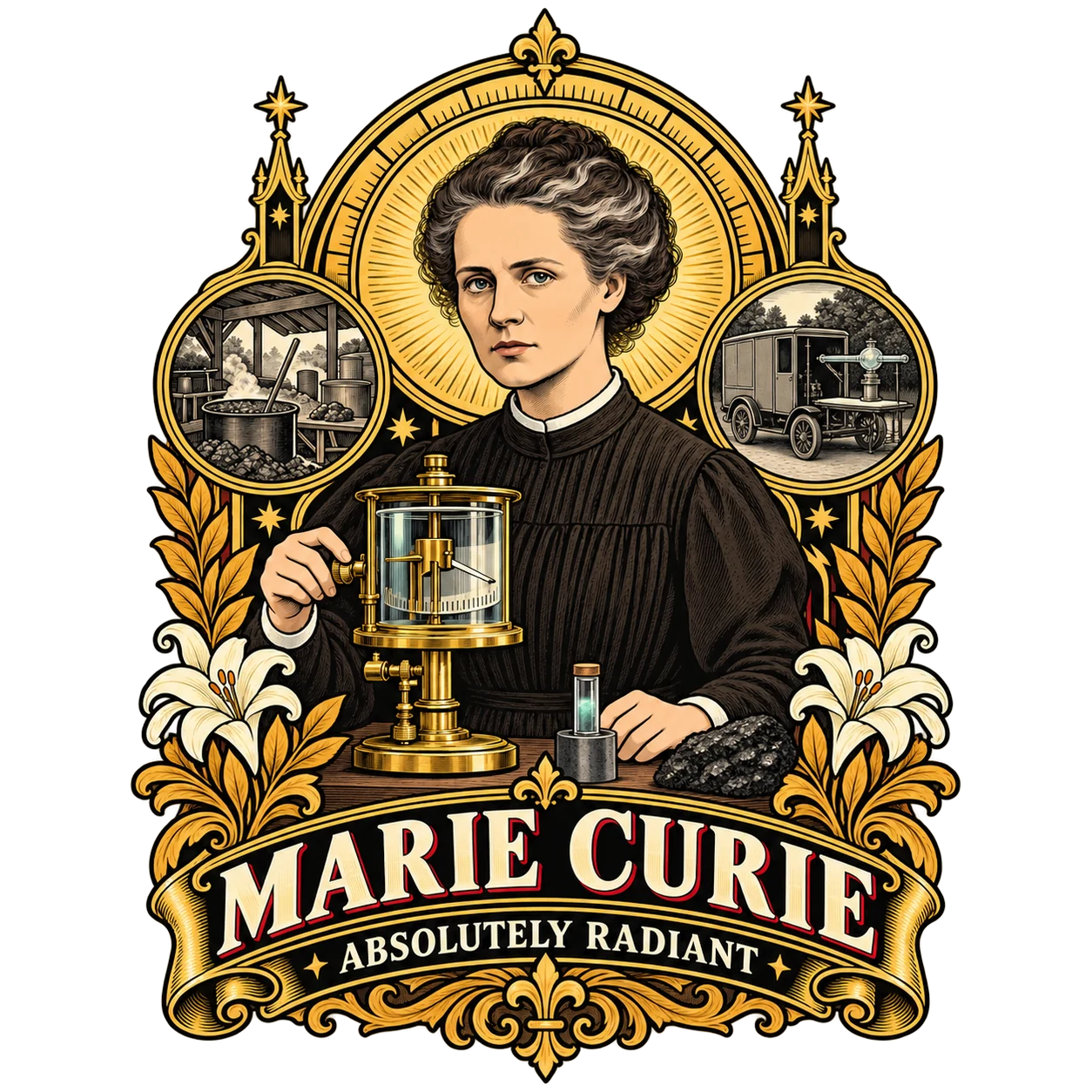
Announcing an element and producing it are different jobs. Curie spent years stirring crushed pitchblende residues in iron cauldrons in a leaking shed, separating fractions until radium could be studied and measured. Miners, industrial processors and technicians worked on the material too, and André Debierne helped isolate metallic radium. The question had been hers, and so was the decision to follow the numbers into several tonnes of waste.
In 1903 she became the first woman in France to receive a doctorate in physics. That year four leading French academicians nominated Becquerel and Pierre for the Nobel Prize in Physics and left her out. One of them, the mathematician Gaston Darboux, had nominated all three the year before. One other nomination that year still named her. The Swedish mathematician Gösta Mittag-Leffler warned Pierre, who replied on 6 August that he very much wished “to be considered together with Madame Curie”. The prize was shared by all three, and she became the first woman to win a Nobel Prize.
In 1906 Pierre was killed by a horse-drawn wagon. The Sorbonne gave Marie his laboratory and his course, which made her the first woman to teach there. In 1908 it made her its first woman professor.
In 1911 the French Academy of Sciences refused to elect her, and the press turned her relationship with the physicist Paul Langevin into a xenophobic scandal. The Swedish chemist Svante Arrhenius, a member of the Royal Swedish Academy of Sciences, which awards the Chemistry Prize, wrote asking her to cable that she would not be coming to Stockholm, and not to accept the prize until the Langevin court case had cleared her. She went, collected the prize for discovering polonium and radium, isolating radium and establishing its compounds, and on 11 December gave her Nobel lecture. She was the first person to win two Nobel Prizes, and she is still the only one to win them in two different sciences.
When the First World War began, she moved the Radium Institute’s radium to safety, then came back to Paris. Surgeons needed to see bullets and shell fragments before they cut. Curie raised money, found cars, generators and X-ray equipment, learned to drive, and equipped eighteen mobile radiology units, later called petites Curies. She and her daughter Irène trained the operators and worked near the front. About two hundred fixed installations followed.
She and Pierre had refused to patent their process for producing radium, because they wanted other researchers to use it. That was generous, and expensive. In 1921 the world’s most famous scientist travelled to the United States so that American women could give her a gram of radium her own institute could not afford.
The radiation that made all this possible was also doing damage nobody yet knew how to manage. She carried samples, worked without modern shielding and took heavy doses of X-rays during the war. She died in 1934 of aplastic anaemia. The Musée Curie is careful about how much of the blame to give radiation, but the years of exposure certainly harmed her.
Some of her laboratory papers are still contaminated, and are handled under controls.
The trouble with Marie Curie
Marie Curie kept making institutions choose between their rules and her evidence. In 1903 leading French academicians nominated Becquerel and Pierre for the Nobel Prize and left her out, though she had been nominated before. The French Academy of Sciences refused to elect her. In 1911 the press made her private life a scandal about a foreigner, and a senior Swedish academician asked her to stay away from Stockholm. She went, and collected her second prize.
What the usual story gets wrong
-
“Marie Curie discovered radioactivity.”
Verdict: False
Henri Becquerel found uranium’s spontaneous radiation in 1896. Curie turned it into a field: she measured it systematically, named it “radioactivity” and showed that it was a property of the atom.
-
“She worked alone.”
Verdict: False
Pierre Curie joined her research, the chemist Gustave Bémont helped with the 1898 separations and co-signed the radium announcement, André Debierne helped isolate metallic radium, and technicians and industrial workers processed the material. The programme, though, was Marie’s design, and the question that started it was hers.
-
“Her notebooks will be dangerous for 1,500 years.”
Verdict: Oversimplified
The contamination is real, and some of her laboratory papers and objects are handled under controls. But the “1,500 years” is a popular figure taken from the half-life of radium-226, not a date after which every notebook becomes safe.
Sources & rabbit holes
The core evidence is her own 1903 doctoral thesis, published in English that year as Radio-Active Substances. The Nobel Foundation’s material is authoritative on the prizes, but often compresses the collaborative work and repeats celebratory anecdotes. The Musée Curie and the Institut Curie give the strongest institutional history, and are more cautious about the cause of her death: the Musée Curie quotes the death certificate issued by the Sancellemoz sanatorium, which gives rapidly progressing, feverish aplastic pernicious anaemia. Susan Quinn’s 1995 biography sets the science in its political context. Her firsts are precise ones: the first woman Nobel laureate, the first woman professor at the Sorbonne, and the only person with Nobels in two different sciences.
Primary sources
-
Radio-active Substances (opens in a new tab)
Free to read. Her doctoral thesis of 1903 in its English translation, setting out the research that found polonium and radium.
Museums & archives
-
Marie Curie – Facts (opens in a new tab)
The prize record for her shared 1903 physics prize, with the citation, her dates and a short summary of her research.
-
Marie Curie – Biographical (opens in a new tab)
The life the Nobel Foundation published when she won her second prize, in chemistry, in 1911, later revised: her education, her Sorbonne professorship, the Radium Institute and her publications.
-
L’héritage de Marie Curie, perpétuer l’esprit d’une pionnière (opens in a new tab)
In French. The Institut Curie on her science and its medical uses, the Radium Institute, and the eighteen cars she had fitted with X-ray equipment in the First World War, later nicknamed “les petites curies”.
-
De quoi est morte Marie Curie ? (opens in a new tab)
In French. The Curie Museum’s short answer: her death certificate records a rapid, feverish aplastic pernicious anaemia, and the museum explains why the part radiation played cannot be measured.
Books
-
Marie Curie: A Life (opens in a new tab)
A full biography that sets her science among the politics and prejudices of the France she worked in. Free to borrow online with an Internet Archive account.
-
Radioactive: Marie & Pierre Curie, A Tale of Love and Fallout (opens in a new tab)
A visual biography that tells the Curies’ love story alongside what their discovery led to. It is an artist’s interpretation, best read with the documents above.
Further reading
-
Marie and Pierre Curie and the discovery of polonium and radium (opens in a new tab)
A full account of the research behind both her prizes, and of her teaching and wartime radiology, first given as a lecture to the Royal Swedish Academy of Sciences.